In a world riddled with disappointment, malice, and tragedy, what rationale do we have for believing in a benevolent God? If God is all-powerful and all-loving, why is there so much evil in the world? John Stackhouse takes a historically informed approach to this dilemma, examining what philosophers and theologians have said on the subject and offering reassuring answers for thoughtful readers.
Stackhouse explores how great thinkers have grappled with the problem of evil--from the Buddha, Confucius, Augustine, and David Hume to Martin Luther, C. S. Lewis, and Alvin Plantinga. Without brushing aside the serious contradictions posed by a God who allows incurable diseases, natural disasters, and senseless crimes to bring misery into our lives, Stackhouse asks if a world completely without evil is what we truly want. Would a life without suffering be a meaningful life? Could free will exist if we were able to choose only good? Stackhouse examines what the best minds have had to say on these questions and boldly affirms that the benefits of evil, in fact, outweigh the costs. Finally, he points to Christian revelation--which promises the transformation of suffering into joy--as the best guide to God's
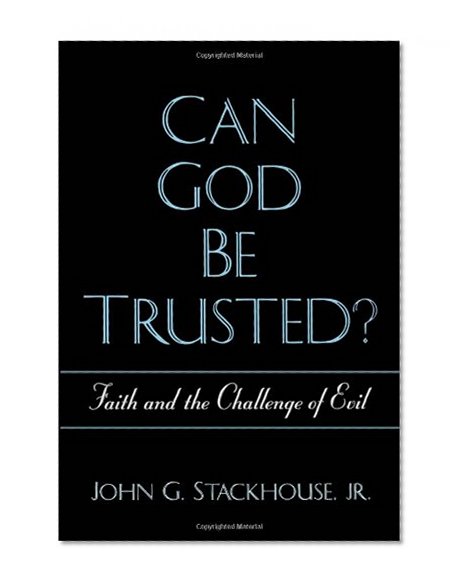
Can God Be Trusted?: Faith and the Challenge of Evil
📄 Viewing lite version
Full site ›
Book Details
Author(s)John G. Stackhouse
PublisherOxford University Press
ISBN / ASIN0195117271
ISBN-139780195117271
AvailabilityUsually ships in 24 hours
Sales Rank1,369,119
CategoryReligion
MarketplaceUnited States 🇺🇸
Description ▲
More Books in Religion
Dogmatics: Volume II - Christian Doctrine of Creation …
View
Onward Christian Athletes: Turning Ballparks into Pulp…
View
Matthew: Structure, Christology, Kingdom
View
The Glory and Honor of God
View
Messages to Myself: Overcoming a Distorted Self-Image
View
Making Your Partnership Work: A Guide for Ministry Lea…
View
The Young Jonathan Edwards: A Reconstruction (Jonathan…
View
Minute Meditations for Healing And Hope
View
A Passion for Truth (Jewish Lights Classic Reprint)
View