Professor McPherson posits that the common rank-and-file soldiers did indeed hold political and ideological beliefs that prodded them to enlist and to fight. His research is based on letters and diaries from 1,076 Union and Confederate soldiers. These reveal many motivations, but always they lead back to duty, honor, and a cause worth dying for. For Cause and Comrades is a fascinating exploration of the 19th-century mind--a mind, it seems, that differs profoundly from our own.
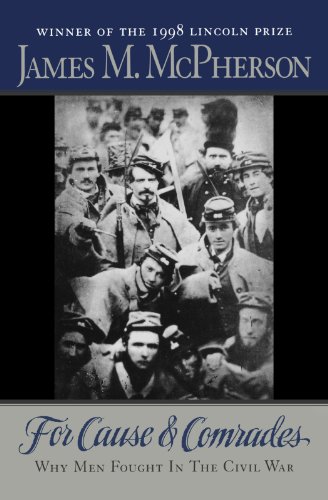
For Cause and Comrades: Why Men Fought in the Civil War
📄 Viewing lite version
Full site ›
18.95
USD
🛒 Buy New on Amazon 🇺🇸
Book Details
Author(s)James M. McPherson,
PublisherOxford University Press
ISBN / ASIN0195124995
ISBN-139780195124996
Sales Rank56,464
CategoryHistory
MarketplaceUnited States 🇺🇸
Description ▲
Consider a war in which 25,000 soldiers are killed or wounded in a single battle, as they were at Gettysburg, or 16,000 in a single day, as at Antietam. The degree of suffering and hardship during the American Civil War has been well documented and analyzed in books and films from Margaret Mitchell's fictional Gone with the Wind to Bell Irvin Wiley's classic studies of Civil War soldiers, The Life of Johnny Reb and The Life of Billy Yank. All these sources agree on the brutality of the combat, but what motivated soldiers to continue fighting under such bitter conditions is the cause of some controversy. Until recently, the common stance has been that soldiers enlisted out of economic need and stayed out of loyalty to their comrades. The respected Civil War historian James M. McPherson weighs in with a different point of view in For Cause and Comrades.
More Books in History
The Bet, and Other Stories
View
Pakistan and the Bomb: Public Opinion and Nuclear Opti…
View
Writing National Histories: Western Europe Since 1800
View
Empire in Eclipse
View
Monks and Laymen in Byzantium, 843-1118
View
The Wilmington and Western Railroad (Images of Rail: D…
View
Black Sailor, White Navy: Racial Unrest in the Fleet d…
View
Feasibility of Laser Power Transmission to a High-Alti…
View
The Democratic Republic: 1801-1815
View