William Haldane opened a cabinet shop in 1836, 14 years before Grand Rapids incorporated. Other furniture companies followed: Berkey and Gay, Widdicomb, Sligh, Hekman, and Phoenix were among those taking advantage of the Grand River for transportation and power, the area's abundant hardwood supply, and a growing immigrant labor pool. The furniture soon attracted national attention. In 1876, the Philadelphia Centennial Exposition proved conclusively that a river town in Michigan had indeed earned the title "Furniture City." Presidents Herbert Hoover, Franklin D. Roosevelt, Harry S. Truman, and Dwight D. Eisenhower all worked at Grand Rapids-made desks. Fifteen manufacturers joined forces to build 1,000 Handley Page bombers during
World War I. The Japanese Instrument of Surrender was signed on September 2, 1945, at a table made in Grand Rapids. Despite fires, floods, strikes, depressions, and wars, Grand Rapids led the industry until the 1950s and 1960s, when the factories began moving to North Carolina. Today the area, along with nearby Holland and Zeeland, dominates the office furniture industry.
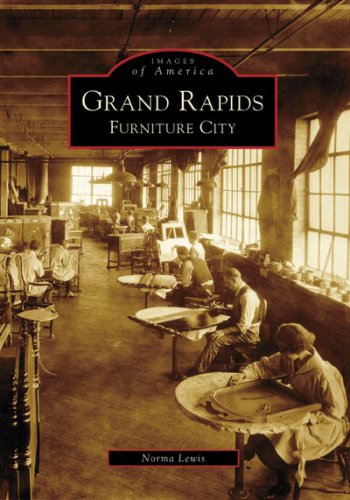
Grand Rapids: Furniture City (Images of America: Michigan)
📄 Viewing lite version
Full site ›
Book Details
Author(s)Norma Lewis
PublisherArcadia Publishing
ISBN / ASIN0738552003
ISBN-139780738552002
AvailabilityUsually ships in 24 hours
Sales Rank160,001
CategoryHistory
MarketplaceUnited States 🇺🇸
Description ▲
More Books in History
The Bet, and Other Stories
View
Pakistan and the Bomb: Public Opinion and Nuclear Opti…
View
Writing National Histories: Western Europe Since 1800
View
Empire in Eclipse
View
Monks and Laymen in Byzantium, 843-1118
View
The Wilmington and Western Railroad (Images of Rail: D…
View
Black Sailor, White Navy: Racial Unrest in the Fleet d…
View
Feasibility of Laser Power Transmission to a High-Alti…
View
The Democratic Republic: 1801-1815
View