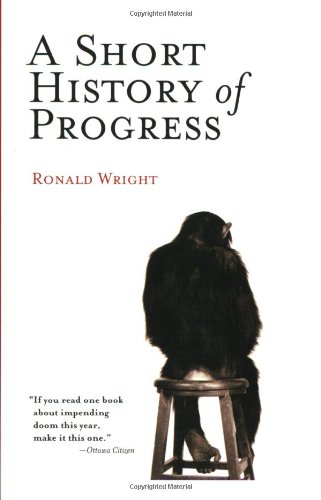
A Short History of Progress
📄 Viewing lite version
Full site ›
Book Details
Author(s)Wright, Ronald
PublisherDa Capo Press
ISBN / ASIN0786715472
ISBN-139780786715473
AvailabilityOnly 2 left in stock - order soon.
Sales Rank7,401
CategoryHistory
MarketplaceUnited States 🇺🇸
Description ▲
No hope, just an awareness of what's being done now and what's been done in the past, is what Ronald Wright will permit in A Short History of Progress, his grim, ammoniacal Massey Lectures, the 43rd in the series. In five lucid, meticulously documented essays, Wright traces the rise and plummet of four regional civilizations--those of Sumer, Rome, Easter Island, and the Maya--and judges that most, perhaps all, of humanity is making and will continue to make mistakes equally disastrous as theirs. He gives general reasons first for not reckoning we'll pull back from the brink. Important among them is an anthropological observation. As individuals, we live long lives. We evolve more slowly than we should, given our lack of vision and our aggressive, selfish nature. We seem to lack the collective wisdom and the insight into cause and effect to realize the limits to what Wright calls the "experiment" of civilization. What Wright calls natural "subsidies" underwrite civilizations' successes. The squandering of those gifts presages inevitable failure, but with careful, canny stewardship, a civilization can manage to muddle through eons. Wright cites Egypt's submission to the limits set by the Nile's annual floods and China's windblown "lump-sum deposit" of topsoil, used for hillside paddies instead of being put to the plough. Wright observes with unrelenting eloquence that our planetary civilization lives precariously, far beyond its means. "Hope drives us to invent new fixes for old messes," he acknowledges, neither claiming nor wanting to be a prophet. We certainly have the tools for change and remediation; we also know what our ancestors did wrong and what happened to them. We're faced, our author observes, with two choices: either do nothing--what he calls "one of the biggest mistakes"--or try to effect "the transition from short-term to long-term thinking." His evidence suggests we're taking the first alternative, which will include a swift, final ride into the dark future on the runaway train of progress. Wright's account tempts one to bet on the rats and roaches. --Ted Whittaker
More Books in History
The Bet, and Other Stories
View
Pakistan and the Bomb: Public Opinion and Nuclear Opti…
View
Writing National Histories: Western Europe Since 1800
View
Empire in Eclipse
View
Monks and Laymen in Byzantium, 843-1118
View
The Wilmington and Western Railroad (Images of Rail: D…
View
Black Sailor, White Navy: Racial Unrest in the Fleet d…
View
Feasibility of Laser Power Transmission to a High-Alti…
View
The Democratic Republic: 1801-1815
View