The first major historical account of gender politics during the Nasser era, Revolutionary Womanhood analyzes feminism as a system of ideas and political practices, international in origin but local in iteration. Drawing connections between the secular nationalist projects that emerged in the 1950s and the gender politics of Islamism today, Laura Bier reveals how discussions about education, companionate marriage, and enlightened motherhood, as well as veiling, work, and other means of claiming public space created opportunities to reconsider the relationship between modernity, state feminism, and postcolonial state-building.
Bier highlights attempts by political elites under Nasser to transform Egyptian women into national subjects. These attempts to fashion a "new" yet authentically Egyptian woman both enabled and constrained women's notions of gender, liberation, and agency. Ultimately, Bier challenges the common assumption that these emerging feminisms were somehow not culturally or religiously authentic, and details their lasting impact on Egyptian womanhood today.
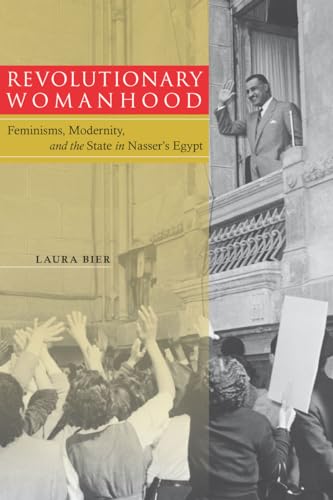
Revolutionary Womanhood: Feminisms, Modernity, and the State in Nasser's Egypt (Stanford Studies in Middle Eastern and Islamic Societies and Cultures)
📄 Viewing lite version
Full site ›
Book Details
Author(s)Bier, Laura
PublisherStanford University Press
ISBN / ASIN0804774390
ISBN-139780804774390
AvailabilityIn Stock
Sales Rank429
CategoryHistory
MarketplaceUnited States 🇺🇸
Description ▲
More Books in History
The Bet, and Other Stories
View
Pakistan and the Bomb: Public Opinion and Nuclear Opti…
View
Writing National Histories: Western Europe Since 1800
View
Empire in Eclipse
View
Monks and Laymen in Byzantium, 843-1118
View
The Wilmington and Western Railroad (Images of Rail: D…
View
Black Sailor, White Navy: Racial Unrest in the Fleet d…
View
Feasibility of Laser Power Transmission to a High-Alti…
View
The Democratic Republic: 1801-1815
View