Why do countries go to war over disputed lands? Why do they fight even when the territories in question are economically and strategically worthless? Drawing on critical approaches to international relations, political geography, international law, and social history, and based on a close examination of the Indian experience during the 20th century, Itty Abraham addresses these important questions and offers a new conceptualization of foreign policy as a state territorializing practice.
Identifying the contested process of decolonization as the root of contemporary Asian inter-state territorial conflicts, he explores the political implications of establishing a fixed territorial homeland as a necessary starting point for both international recognition and national identity—concluding that disputed lands are important because of their intimate identification with the legitimacy of the postcolonial nation-state, rather than because of their potential for economic gains or their place in historic grievances.
By treating Indian diaspora policy and geopolitical practice as exemplars of foreign policy behavior, Abraham demonstrates how their intersection offers an entirely new way of understanding India's vexed relations with Pakistan and China. This approach offers a new and productive way of thinking about foreign policy and inter-state conflicts over territory in Asia—one that is non-U.S. and non-European focused—that has a number of implications for regional security and for foreign policy practices in the contemporary postcolonial world.
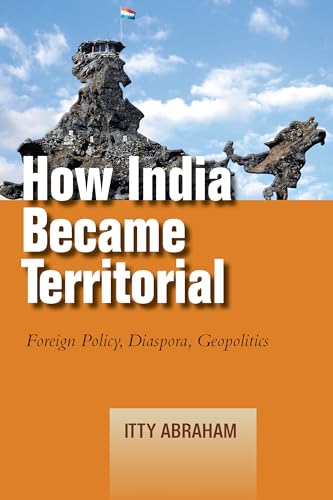
How India Became Territorial: Foreign Policy, Diaspora, Geopolitics (Studies in Asian Security)
📄 Viewing lite version
Full site ›
Book Details
Author(s)Itty Abraham
PublisherStanford University Press
ISBN / ASIN0804791635
ISBN-139780804791632
AvailabilityUsually ships in 24 hours
Sales Rank1,180,145
CategoryPolitical Science
MarketplaceUnited States 🇺🇸
Description ▲
More Books in Political Science
The Millennium Development Goals and Beyond: Internati…
View
Transnational Networks in Regional Integration: Govern…
View
Forensic Psychophysiology Using the Polygraph: Scienti…
View
Gender, Islam and Democracy in Indonesia (ASAA Women i…
View
E-Governance: A Change Management Tool
View
Shop Floor Bargaining and the State: Historical and Co…
View
Red State Uprising: How to Take Back America
View
A Community Health Approach to the Assessment of Infan…
View
Foreign Aid and Landmine Clearance: Governance, Politi…
View