The'Man Bites Dog' story of over 1,000 highnet- worth individuals who rose up to protest the repeal of the estate tax made headlines everywhere last year. Central to the organization of what Newsweek tagged the 'billionaire backlash' were two visionaries: Bill Gates, Sr., cochair of the Bill and Melinda Gates Foundation, the largest foundation on earth, and Chuck Collins, cofounder of United for a Fair Economy and Responsible Wealth, and the great-grandson of meat packer Oscar Mayer who gave away his substantial inheritance at the age of twenty-six.
Gates and Collins argue that individual wealth is a product not only of hard work and smart choices but of the society that provides the fertile soil for success. They don't subscribe to the'Great Man' theory of wealth creation but contend that society's investments, such as economic development, education, health care, and property rights protection, all contribute to any individual's good fortune. With the repeal proposed by the Bush administration, we might be facing the future that Teddy Roosevelt feared-where huge fortunes amassed and untaxed would evolve into a dangerous and permanent aristocracy. Repeal would drop federal revenues $294 billion in the first 10 years; 27 some $750 billion would be lost in the second decade, not to mention that the U.S. Treasury estimates that charitable contributions would drop by $6 billion a year.
But what about all those modest families that would lose the farm? Gates and Collins expose the fallacy of this argument, pointing out that this is largely a myth and that the very same lobbies and politicians who are crying'cows' have opposed other legislation that would actually have helped small farmers. Weaving in personal narratives, history, and plenty of solid economic sense, Gates and Collins make a sound and compelling case for tax reform, not repeal.
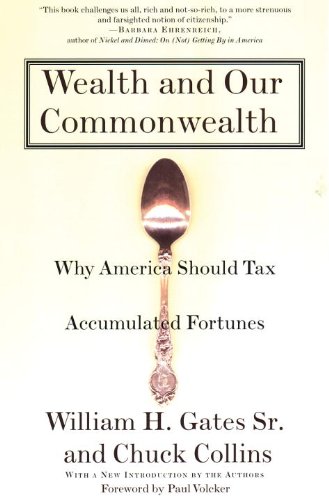
Wealth and Our Commonwealth: Why America Should Tax Accumulated Fortunes
📄 Viewing lite version
Full site ›
Book Details
Author(s)William H. Gates, Chuck Collins
PublisherBeacon Press
ISBN / ASIN080704718X
ISBN-139780807047187
AvailabilityUsually ships in 24 hours
Sales Rank1,729,961
CategoryBusiness & Economics
MarketplaceUnited States 🇺🇸
Description ▲
More Books in Business & Economics
Business Cycles and Forecasting
View
Development Economics: Its Position in the Present Sta…
View
Cost Systems Design
View
So You Want to Dance on Broadway
View
The Blueprint: Reviving Innovation, Rediscovering Risk…
View
Managing IT Outsourcing, Second Edition
View
Education and the Creation of Capital in the Early Ame…
View
Global Corruption Report 2005: Special Focus: Corrupti…
View
More Tales for Trainers: Using Stories and Metaphors t…
View