Among the most amusing bits here (though the primer to banal acknowledgments wins hands down) is Hamilton's list not of the bestselling books, which gather momentum just by being popular, but of the best-stolen books. These, he says, are the books people really want. Topping the list, as the Gideons are well aware, is the Bible, the stealing of which, Hamilton muses, "might seem to defeat the purpose of wanting it in the first place: salvation." Even the Waldorf Astoria stocks used books, "so wealthy guests can steal them." Of course, most struggling writers would love to write a book so desired it becomes theft-worthy. A book's success, though, says Hamilton, depends largely on "the talent that best serves a writer," luck. "Sometimes," he adds, "the worst luck, like dropping dead, can be the most fortuitous of all." --Jane Steinberg
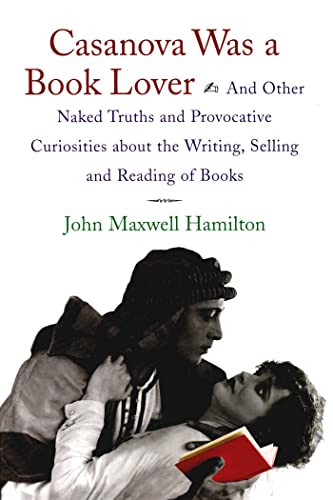
Casanova Was A Book Lover: And Other Naked Truths and Provocative Curiosities about the Writing, Selling, and Reading of Books
📄 Viewing lite version
Full site ›
Book Details
Author(s)John Maxwell Hamilton
PublisherLSU Press
ISBN / ASIN0807125547
ISBN-139780807125540
AvailabilityUsually ships in 24 hours
Sales Rank3,160,096
CategoryLanguage Arts & Disciplines
MarketplaceUnited States 🇺🇸
Description ▲
"To all reviewers," John Maxwell Hamilton dedicates Casanova Was a Book Lover. "Because only ungrateful asses would pan a book after having it dedicated to them." Hamilton needn't have taken the precaution. According to his editor, "Our modern reviewer is like a counselor at a self-esteem camp." If so, then gather round the fire, campers--it's time to enlarge Mr. Hamilton's ego. Hamilton's inquiry into the world of books and writing and publishing is sharp, fresh, and witty--erudite but devoid, thankfully, of academese. Each chapter addresses a single, often quirky aspect of the book world. One bemoans the idiocy of most acknowledgments pages, another the cheerleading and book-reportish quality of contemporary reviewing. The book's first chapter examines the writer's economic struggle, cheerily noting the convenience, in this regard, of his or her being in jail: "the big advantage ... is that a writer need not worry about making money or fret about having to take time out for cooking or doing the laundry." Later chapters include an etiquette guide for authors and readers ("reading your friend's book is a nice thing to do, but not required"--whew!), a survey of bad writing by presidents of the United States, and an exploration of the complicated decision-making that takes place at the inundated Library of Congress.
More Books in Language Arts & Disciplines
The Quest for Charisma: Christianity and Persuasion
View
Read the Way You Talk: A Guide for Lectors
View
Focus on the Caribbean (Varieties of English Around th…
View
How to Write a Novel; A Practical Guide to the Art of …
View
How to Write and Sell Mystery Fiction
View
Politically Speaking: A Worldwide Examination of Langu…
View
The Memoir Book
View
The Subjunctive in the Age of Prescriptivism: English …
View
Invisible Acts of Power: Channeling Grace in Your Ever…
View