The beginning of the twentieth century witnessed a remarkable growth of corporate welfare programs in American industry. By the mid-1920s, 80 percent of the nation's largest companies--firms including DuPont, International Harvester, and Metropolitan Life Insurance--engaged in some form of welfare work. Programs were implemented to achieve goals that ranged from improving basic workplace conditions, to providing educational, recreational, and social opportunities for workers and their families, to establishing savings and insurance plans.
Employing the critical lens of gender analysis, Nikki Mandell offers an innovative perspective on the development of corporate welfare. She argues that its advocates sought to build a new relationship between labor and management by recasting the modern corporation as a Victorian family. Employers assumed the authoritative position of fathers, assigned their employees the subordinate role of children, and hired male and female welfare managers to act as "corporate mothers" charged with creating a harmonious household. But internal conflict and external pressures weakened the corporate welfare system, and it eventually gave way to a system of personnel management and employee representation. With the abandonment of the familial model, the form of corporate welfare changed; but, as Mandell demonstrates, its content left an enduring legacy for modern industrial relations.
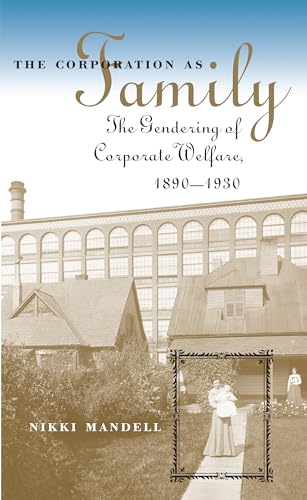
The Corporation as Family: The Gendering of Corporate Welfare, 1890-1930 (The Luther H. Hodges Jr. and Luther H. Hodges Sr. Series on Business, Entrepreneurship, and Public Policy)
📄 Viewing lite version
Full site ›
Book Details
Author(s)Nikki Mandell
ISBN / ASIN0807853518
ISBN-139780807853511
AvailabilityUsually ships in 24 hours
Sales Rank2,505,775
CategoryBusiness & Economics
MarketplaceUnited States 🇺🇸
Description ▲
More Books in Business & Economics
Business Cycles and Forecasting
View
Development Economics: Its Position in the Present Sta…
View
Cost Systems Design
View
So You Want to Dance on Broadway
View
The Blueprint: Reviving Innovation, Rediscovering Risk…
View
Managing IT Outsourcing, Second Edition
View
Education and the Creation of Capital in the Early Ame…
View
Global Corruption Report 2005: Special Focus: Corrupti…
View
More Tales for Trainers: Using Stories and Metaphors t…
View