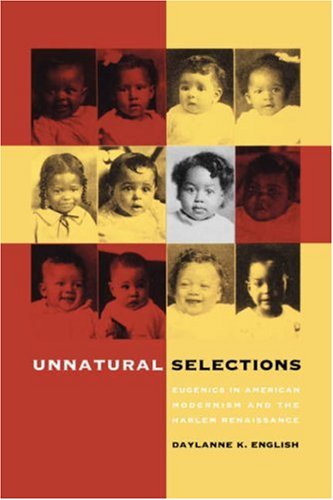
English's interdisciplinary approach brings together the work of those canonical writers with relatively neglected literary, social scientific, and visual texts. She examines antilynching plays by Angelina Weld Grimk© as well as the provocative writings of white female eugenics field workers. English also analyzes The Crisis magazine as a family album filtering uplift through eugenics by means of photographic documentation of an ever-improving black race.
English suggests that current scholarship often misreads early-twentieth-century visual, literary, and political culture by applying contemporary social and moral standards to the past. Du Bois, she argues, was actually more of a eugenicist than Eliot. Through such reconfiguration of the modern period, English creates an allegory for the American present: because eugenics was, in its time, widely accepted as a reasonable, progressive ideology, we need to consider the long-term implications of contemporary genetic engineering, fertility enhancement and control, and legislation promoting or discouraging family growth.