In Decadent Style, John Reed defines “decadent art†broadly enough to encompass literature, music, and the visual arts and precisely enough to examine individual works in detail. Reed focuses on the essential characteristics of this style and distinguishes it from non–esthetic categories of “decadent artists†and “decadent themes.â€
Like the natural sciences and psychology, the arts in the late nineteenth century reflect an interest in the process of atomization. Literature and the other arts mirror this interest by developing, or rather elaborating, existing forms to the point of what appears to be dissolution. Instead of these forms dissolving, however, they require their audience’s participation and thus involve a new order. Reed argues that this process of reordering characterizes decadent style, which depends upon sensory provocation resolvable only through negation and is therefore bounded by philosophical and emotional assumptions of inevitable frustration.
Drawing upon the literature, music, and visual arts of England and Europe at the end of the nineteenth century, Reed provides a widely ranging and authoritative overview of decadent style, which relates such artists as Huysmans, Wilde, D’Annunzio, Moreau, Bresdin, Klimt, Klinger, Wagner, and Strauss. He related decadent style to Pre–Raphaelite and Naturalist preoccupation with detail and to aesthetic and Symbolist fascination with sensibility and idealism. Ultimately, Reed argues, decadent style is a late stage of Romanticism, overshadowed by Symbolism but anticipating, in its attempt to yoke incompatibilities and to engender a new cerebral form, some of the main traits of Modernism.
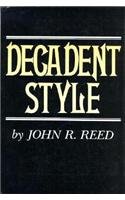
Decadent Style
📄 Viewing lite version
Full site ›
Book Details
Author(s)John R. Reed
PublisherOhio University Press
ISBN / ASIN0821407937
ISBN-139780821407936
AvailabilityUsually ships in 4 to 6 weeks
Sales Rank2,963,343
MarketplaceUnited States 🇺🇸