Cohen delves into the rupture that has occurred between the middle class, the individual, and the nation in Morocco and elsewhere around the world. Combining institutional economic analysis with cultural theory and ethnographic observation including interviews with seventy young adults in Casablanca and Rabat, she reveals how young, urban, educated Moroccans conceive of their material, social, and political conditions. She finds that, for the most part, they perceive improvement in their economic and social welfare apart from the types of civic participation commonly connected with nationalism and national identity. In answering classic sociological questions about how the evolution of capitalism influences identity, Cohen sheds new light on the measurable social and economic consequences of globalization and on its less tangible effects on individuals’ perception of their place in society and prospects in life.
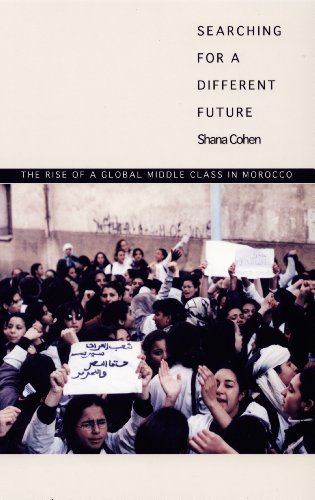
Searching for a Different Future: The Rise of a Global Middle Class in Morocco
📄 Viewing lite version
Full site ›
Book Details
Author(s)Shana Cohen
PublisherDuke University Press Books
ISBN / ASIN0822333872
ISBN-139780822333876
AvailabilityUsually ships in 24 hours
Sales Rank4,048,969
CategoryPolitical Science
MarketplaceUnited States 🇺🇸
Description ▲
By examining how neoliberal economic reform policies have affected educated young adults in contemporary Morocco, Searching for a Different Future posits a new socioeconomic formation: the global middle class. During Morocco’s postcolonial period, from the 1950s through the 1970s, development policy and nationalist ideology supported the formation of a middle class based on the pursuit of education, employment, and material security. Neoliberal reforms adopted by Morocco since the early 1980s have significantly eroded the capacity of the state to nurture the middle class, and unemployment and temporary employment among educated adults has grown. There is no longer an obvious correlation between the best interests of the state and those of the middle-class worker. As Shana Cohen demonstrates, educated young adults in Morocco do not look toward the state for economic security and fulfillment but toward the diffuse, amorphous global market.
More Books in Political Science
The Millennium Development Goals and Beyond: Internati…
View
Transnational Networks in Regional Integration: Govern…
View
Forensic Psychophysiology Using the Polygraph: Scienti…
View
Gender, Islam and Democracy in Indonesia (ASAA Women i…
View
E-Governance: A Change Management Tool
View
Shop Floor Bargaining and the State: Historical and Co…
View
Red State Uprising: How to Take Back America
View
A Community Health Approach to the Assessment of Infan…
View
Foreign Aid and Landmine Clearance: Governance, Politi…
View