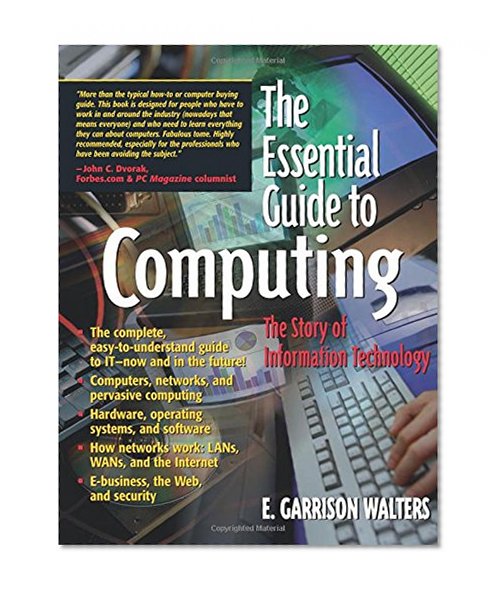
The Essential Guide to Computing: The Story of Information Technology Buy on Amazon
Facebook LinkedIn

The Essential Guide to Computing: The Story of Information Technology

Publisher Prentice Hall
Category Computers
25.48 44.99 -43% USD

Usually ships in 24 hours

Book Details
Publisher Prentice Hall
ISBN / ASIN 0130194697
ISBN-13 9780130194695
Availability Usually ships in 24 hours
Sales Rank #209,481
Category Computers
Marketplace United States 🇺🇸
Ratings & Reviews No reviews yet — be the first!

No reviews yet.

Description
Lots of circumstances conspired to make information technology what it is today. Business decisions (both wise and foolish), scientific discoveries (both old and recent), marketing campaigns (founded both in truth and otherwise), and plenty of random chance have played parts in defining the industrial, social, and cultural phenomena that personal and business computing have become. The Essential Guide to Computing: The Story of Information Technology tells the technical, commercial, and social stories behind the electronic computer and related technologies, such as telecommunications and software development. Along the way, author E. Garrison Walters reveals a lot of general knowledge about computers. This book is highly readable. It's essentially a general-interest nonfiction book, and a good one, at that.

As you read this book, you can't avoid picking up the little technical facts that have become part of our culture, particularly its younger parts. What's an embedded operating system? What's object-oriented programming? What is the open-source movement? Walters teaches you enough about these subjects--and the ways in which they fit together--to enable you to speak intelligently about them and perform further research, as your needs require. You'll enjoy this book, regardless of your level of computer expertise or your area of specialization, because you're sure to learn something and enjoy the process. --David Wall

Topics covered: The state of the art in electronic computing, data storage, and data communications, in a historical context. The operations of processors, memory chips, persistent storage devices (e.g., disks), and other hardware subsystems. Software development--including compression, encryption, and the challenges and promise of parallel computing--receives attention. Ditto for network communications infrastructures, protocols, and applications. It's all explained in detail and with style.

Donate to EbookNetworking
Previous Book Handbook on Enterprise Arch... Next Book Principles of Computer Secu...
Previous Handbook on Enter...
Next Principles of Com...
