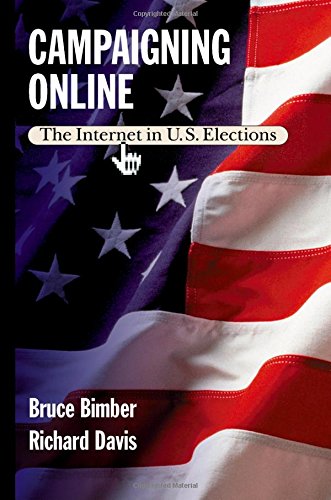


Campaigning Online: The Internet in U.S. Elections
Book Details
Author(s)
Bruce A. Bimber, Richard Davis
Publisher
Oxford University Press
ISBN / ASIN
0195151569
ISBN-13
9780195151565
Availability
Usually ships in 1-2 business days
Sales Rank
#3,594,698
Category
Political Science
Marketplace
United States 🇺🇸
Description
After a self-assured John F. Kennedy bested a visibly shaky Richard Nixon in their famous 1960 debates, political television, it was said, would henceforth determine elections. Today, many claim the Internet will be the latest medium to revolutionize electoral politics. Candidates invest heavily in web and email campaigns to reach prospective voters, as well as to communicate with journalists, potential donors, and political activists. Do these efforts influence voters, expand democracy, increase the coverage of political issues, or mobilize a shrinking and apathetic electorate?
Campaigning Online answers these questions by looking at how candidates present themselves online and how voters respond to their efforts-including whether voters learn from candidates' websites and whether voters' views are affected by what they see. Although the Internet will not lead to a revolution in democracy, it will, Bimber and Davis argue, have consequences: reinforcing messages, mobilizing activists, and strengthening partisans' views. Reporting on a wealth of new data drawn from national and state-wide surveys, laboratory experiments, interviews with campaign staff, and analysis of web sites themselves, Campaigning Online draws the most complete picture of the role of campaign websites in American elections to date.
Campaigning Online answers these questions by looking at how candidates present themselves online and how voters respond to their efforts-including whether voters learn from candidates' websites and whether voters' views are affected by what they see. Although the Internet will not lead to a revolution in democracy, it will, Bimber and Davis argue, have consequences: reinforcing messages, mobilizing activists, and strengthening partisans' views. Reporting on a wealth of new data drawn from national and state-wide surveys, laboratory experiments, interviews with campaign staff, and analysis of web sites themselves, Campaigning Online draws the most complete picture of the role of campaign websites in American elections to date.


