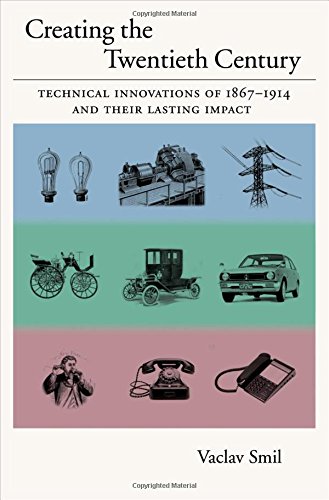


CREATING THE 20TH CENTURY (Technical Revolutions and Their Lasting Impact)
Book Details
Author(s)
SMIL
Publisher
Oxford University Press, USA
ISBN / ASIN
0195168747
ISBN-13
9780195168747
Availability
Usually ships within 7 to 8 days
Sales Rank
#1,259
Category
Hardcover
Marketplace
United States 🇺🇸
Ratings & Reviews
No reviews yet — be the first!
No reviews yet.
Description
The period between 1867 and 1914 remains the greatest watershed in human history since the emergence of settled agricultural societies: the time when an expansive civilization based on synergy of fuels, science, and technical innovation was born. At its beginnings in the 1870s were dynamite, the telephone, photographic film, and the first light bulbs. Its peak decade - the astonishing 1880s - brought electricity - generating plants, electric motors, steam turbines, the gramophone, cars, aluminum production, air-filled rubber tires, and prestressed concrete. And its post-1900 period saw the first airplanes, tractors, radio signals and plastics, neon lights and assembly line production. This book is a systematic interdisciplinary account of the history of this outpouring of European and American intellect and of its truly epochal consequences. It takes a close look at four fundamental classes of these epoch-making innovations: formation, diffusion, and standardization of electric systems; invention and rapid adoption of internal combustion engines; the unprecedented pace of new chemical syntheses and material substitutions; and the birth of a new information age. These chapters are followed by an evaluation of the lasting impact these advances had on the 20th century, that is, the creation of high-energy societies engaged in mass production aimed at improving standards of living.
Similar Products


