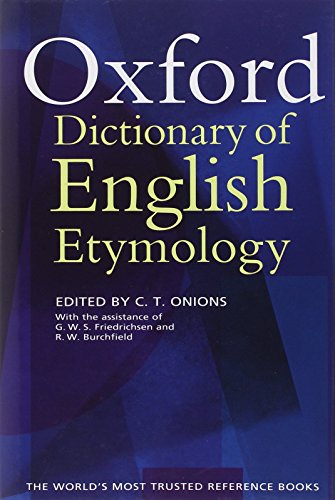


The Oxford Dictionary of English Etymology
Book Details
Author(s)
C.T. Onions
Publisher
Oxford University Press
ISBN / ASIN
0198611129
ISBN-13
9780198611127
Availability
In Stock.
Sales Rank
#192,195
Marketplace
United States 🇺🇸
Ratings & Reviews
No reviews yet — be the first!
No reviews yet.
Description
Dr. C.T. Onions first joined the staff of the Oxford English Dictionary in 1895. He worked on the OED, the Shorter OED, and then published his Shakespeare Glossary in 1911. A wonderful and learned scholar, he died in 1966 as the first edition of The Oxford Dictionary of English Etymology was going to press. Assisted by G.W.S. Friedrichsen and R.W. Burchfield, Onions created a magnificent work of erudition, with 24,000 main entries. Including their derivatives, the dictionary delves into the origins of more than 38,000 words.
For each entry, the dictionary provides the correct pronunciation, followed by a short definition, and the century and source of the word's first recording. Then come the etymological notes. Thus one learns that "froth" (an aggregation of small bubbles on liquid) was first noted in the 14th century, in Sir Gawain and the Bible, that it comes from the Old Norse frooa, and was taken from there into German (fraup) and Old English (froth). Now in its fifth printing and a standard reference for scholars, Onions's opus is still the most comprehensive etymological dictionary of English ever to be published. --Stephanie Gold
Similar Products
