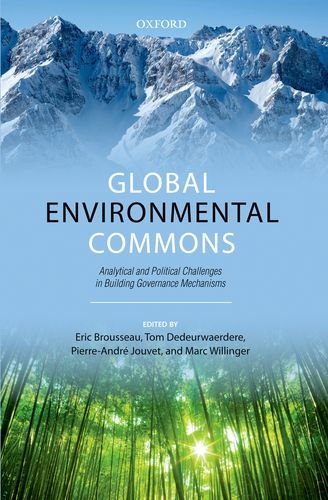


Global Environmental Commons: Analytical and Political Challenges in Building Governance Mechanisms
Book Details
PublisherOxford University Press
ISBN / ASIN0199656207
ISBN-139780199656202
AvailabilityUsually ships in 24 hours
Sales Rank1,932,353
MarketplaceUnited States 🇺🇸
Description
Environmental challenges, and the potential solutions to address them, have a direct effect on living standards, the organization of economies, major infrastructures, and modes of urbanization. Since the publication of path-breaking contributions on the governance of environmental resources in the early 1990s, many political initiatives have been taken, numerous governance experiments have been conducted, and a large multi-disciplinary field of research has opened up. This interdisciplinary book takes stock of the knowledge that has accumulated to date, and addresses new challenges in the provision of environmental goods. It focuses on three essential dimensions with respect to governance. First, it addresses the issue of designing governance solutions through analyzing systems of rules, and levels of organization, in the governance and management of environmental issues. Second, it draws renewed attention to the negotiation processes among stakeholders playing a crucial role in reaching agreements over issues and solutions, and in choosing and implementing particular policy instruments. Finally, it shows that compliance depends on a combination of formal rules, enforced by recognized authorities, and informal obligations, such as social and individual norms.
The evolution of the research frontiers on environmental governance shows that more legitimate and informed processes of collective decision, and more subtle and effective ways of managing compliance, can contribute to more effective policy. However, this book also illustrates that more democratic and effective governance should rely on more direct and pluralistic forms of involvement of citizens and stakeholders in the collective decision making processes
The evolution of the research frontiers on environmental governance shows that more legitimate and informed processes of collective decision, and more subtle and effective ways of managing compliance, can contribute to more effective policy. However, this book also illustrates that more democratic and effective governance should rely on more direct and pluralistic forms of involvement of citizens and stakeholders in the collective decision making processes
