No reviews yet.
Amazon Exclusive: A Letter from Xander Bennett, Author of Screenwriting Tips, You Hack
Dear Amazon Readers,
Thanks for checking out my book here on Amazon. Since you're reading this page, I already know a few things about you: You're interested in screenwriting, and you're looking for some advice, guidance, and encouragement. Here's where I convince you that you've come to the right place.
Let's face it, there are a lot of screenwriting books out there. I've read them; you've probably read them too. Many of them are either very serious, woefully outdated, or chiefly concerned with format and structure. Some of the most popular ones offer readers a “one true way”--a supposedly foolproof formula for writing the perfect screenplay.
My book is a little different.
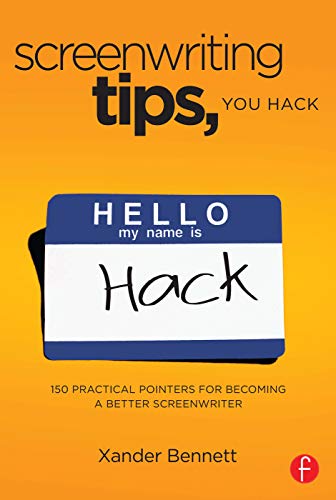
For starters, I'm going to call you a hack. I mean, it's right there in the title, so there's really no way around it short of covering the book with a paper bag. Why? Because I believe we're all hacks: you, me, and every hard-working writer out there. Even the most experienced writers suffer from anxiety, that feeling that we're not smart enough or strong enough to write the perfect screenplay that exists in our heads. Heck, even Shakespeare complained about how hard it was to be a writer. If we're hacks, then we're in good company. Let's wear it like a badge of honor.
This book also breaks from the pack when it comes to content. Sure, I'll tell you the basics: how to write three-act structure, how to write a great logline, how to get an agent (although, these days, it's more likely to be a manager). But I'll also give you the kind of advice you can't learn anywhere else. For instance:
There are a lot of screenwriting advice books out there, but I think you'll find this one's a little different. It won't lie to you, lecture you, or sugar-coat the truth. What it will do is give you a broad range of tricks and techniques with which to tackle your next screenplay. Whether you're about to write your first spec script or your tenth, Screenwriting Tips, You Hack will help you on your journey.
Good luck and happy writing!
--Xander Bennett
P.S. I solemnly vow that this book contains none of the following words: "filmic," "diegesis," "mise-en-scene," or "auteur." And that's a guarantee.
Three Bonus Screenwriting Tips from Xander Bennett Not Found in Screenwriting Tips, You Hack
1. Stuck on characterization? Sample and remix.
What's your protagonist's worldview, the unique way of looking at things that sets her apart? How do you make Minion #2 a different person from Minion #1? And what kind of quirk or mannerisms might you use to bring your secondary characters into the spotlight?
Characterization--making fictional people seem real--is hard work. Or is it? If you're looking for the cheap and easy route to character, think remixing. Actors do this all the time ("I'm going to play this crooked businessman like early DeNiro, with a dash of George Bush") and you can do it too. Take a character you know, mix them up and drop them into a new role. Write your love interest as a female version of Gaius Baltar; your sidekick as a teenage Seth Rogen; your villain as "Julius Caesar meets my great-aunt Hilda." Don't worry, the Character Police aren't going to bust your door down for taking inspiration wherever you can find it.
2. Develop your voice.
Writers are supposed to have a "voice," right? It's that inimitable style that sets you apart, that makes your scripts read differently from all the others out there. Having a voice is about letting a part of yourself shine through your screenplay... and screenwriting is about selling yourself (or so they say). So how do you get one?
Do what all budding novelists do: start by emulating your favorite writer. This comes naturally to prose authors, but for screenwriters it's not so intuitive. Perhaps it's because we watch movies more than we read scripts, but for many writers their first script is written in a passionless, neutral tone. Well, that ain't going to stand out from the pack. Forget what they say about screenplays being "blueprints." Screenplays are symphonies... and you can't make music without passion and style.
How do you find your style? Read a lot of scripts to see what the pros' voices sound like. JJ Abrams doesn't read like Aaron Sorkin, who doesn't read like Kurtzman and Orci. Analyze the speed of an Abrams script, or the patter of Sorkin's dialogue, and try to emulate it in your own writing. At first you'll just be copying. But then you'll see the underlying structure, the shape and cadence of a pro writer's style, and your own unique voice will start to take form.
3. Video game scripts benefit from mystery more than other screenplays.
In game scripts, even more than other forms of writing, less is more. Partly this is because no player enjoys having control taken away from them--unskippable cutscenes, long intros and pages of elaborate backstory often feel like distractions from the gameplay. Trimming a few lines of NPC dialog, or shortening a popup text box by just a few sentences, can dramatically increase player engagement in the story. What they lose in understanding they make up for in, well, actually caring about your script.
It's also because solving puzzles, exploring narratives and uncovering mysteries is what game players do. They're among the smartest, most engaged screen audiences because they have a direct stake in the story: they're playing it! This allows you to create the sense of a vast world through judicious sprinkling of story clues (as in Bioshock) or through clever use of atmosphere and background details (see Amnesia: The Dark Descent). Portal tells a gripping, life-and-death story with only two characters (one of whom is mute); much of that narrative success can be attributed to never explaining the situation or talking down to the player. In video games, you can write a mystery and expect your audience to engage with it... and probably solve it.