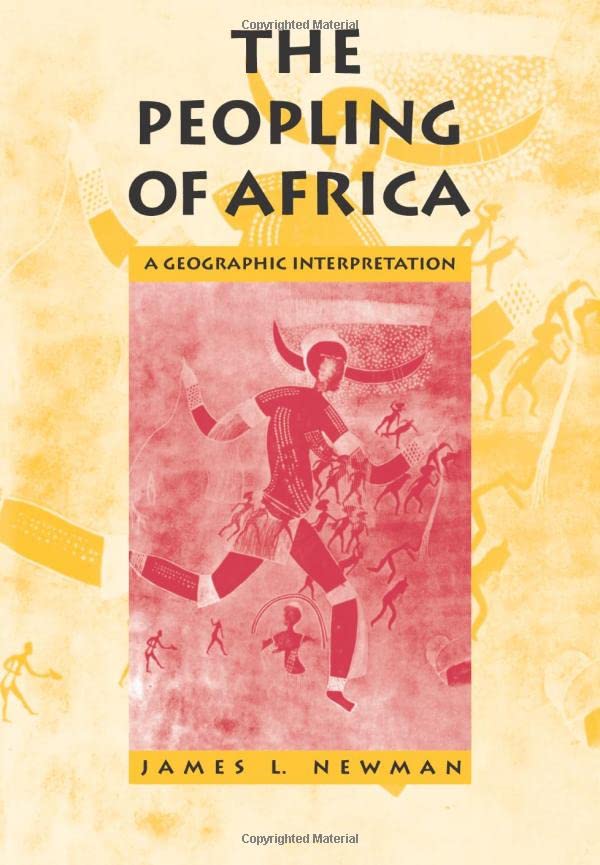


The Peopling of Africa: A Geographic Interpretation
Book Details
Author(s)
James L. Newman
Publisher
Yale University Press
ISBN / ASIN
0300072805
ISBN-13
9780300072808
Availability
Usually ships in 24 hours
Sales Rank
#696,193
Category
History
Marketplace
United States 🇺🇸
Ratings & Reviews
No reviews yet — be the first!
No reviews yet.
Description
Discovering the African past takes one on a journey back to the origins of humanity over four million years ago, which is where James L. Newman begins his account of the continent's peoples. He ends it at the onset of the colonial era in the late nineteenth century, noting that "Africa and Africans deserve to be known on their own terms, and to achieve this goal we need to improve our understanding of what took place before colonialism rewrote many of life's rules."
African identities constitute one of Newman's main themes, and thus he discusses the roles played by genetic background, language, occupation, and religion. Population distribution is the other main theme running through the book. As a geographer, the author uses regions, spaces, and places as his filters for viewing how Africans have responded through time to differing natural and human environmental circumstances. Drawing on the fields of biology, archaeology, linguistics, history, anthropology, and demography, as well as geography, Newman describes the richness and diversity of Africa's inhabitants, the technological changes that transformed their lives, how they formed polities from small groups of kin to states and empires, and how they were influenced by external forces, particularly the slave trade. Maps are an important part of the book, conveying information and helping readers interrelate local, regional, continental, and global contexts.
African identities constitute one of Newman's main themes, and thus he discusses the roles played by genetic background, language, occupation, and religion. Population distribution is the other main theme running through the book. As a geographer, the author uses regions, spaces, and places as his filters for viewing how Africans have responded through time to differing natural and human environmental circumstances. Drawing on the fields of biology, archaeology, linguistics, history, anthropology, and demography, as well as geography, Newman describes the richness and diversity of Africa's inhabitants, the technological changes that transformed their lives, how they formed polities from small groups of kin to states and empires, and how they were influenced by external forces, particularly the slave trade. Maps are an important part of the book, conveying information and helping readers interrelate local, regional, continental, and global contexts.