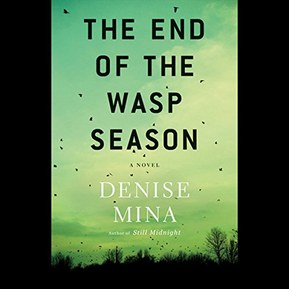
The End of the Wasp Season: A Novel (Alex Morrow)
No reviews yet.
Meanwhile, in a wealthy suburb of Glasgow, a young woman is found savagely murdered. The community is stunned by what appears to be a vicious, random attack. When Detective Inspector Alex Morrow, heavily pregnant with twins, is called in to investigate, she soon discovers that a tangled web of lies lurks behind the murder. It's a web that will spiral through Alex's own home, the local community, and ultimately right back to a swinging rope, hundreds of miles away.
The End of the Wasp Season is an accomplished, compelling and multi-layered novel about family's power of damage-and redemption.
In this Amazon exclusive, author Denise Mina is interviewed by fellow author Kate Atkinson (Started Early, Took My Dog).
Kate Atkinson: Do you have a lot of books planned ahead? Does it worry you that you ll die before you write them all. (My own paranoia is on display here, obviously.)
Denise Mina: My books tend to unfold as I write them and start with a very nebulous idea. I know some writers have notepads full of ideas they re waiting to get around to. I used to keep a note pad and found it recently and it was full of dreamlike nonsense. One memorable entry-- King and Queen of Moon'--what the hell is that?
For me the best books to write, if not to read, are small ideas that snowball out of nothing much at all.
I still have two Paddy Meehan books to write but I m glad they re not done now. If I d written them before the Murdoch scandal I d have missed out so much juicy stuff.
I ve never had much of a horror of death. I m so busy now that whenever I think about dying I comfort myself with the knowledge that at least I ll get to sit down for half an hour.
Atkinson: Your characters are very well-rounded, not ciphers as in some novels (crime and otherwise). Do you become attached to them or are you aware you re using them as fictional devices?
Mina: I get very attached to them. When Facebook first started and I was looking up/stalking old friends, I actually typed in half of Maureen O Donnell s name before I remembered that she wasn t real. I usually base my heroes on admirable aspects of people I know, so maybe that makes them seem more real to me. They never feel like ciphers to me, especially not by the time I ve finished a book. Then they usually feel like someone I like but I ve been spending far too much time with.
Atkinson: You haven t always been a writer and could, I suspect, have succeeded in many different fields. If you could have completely free rein what path would you have chosen?
Mina: Nah, I was unsuccessful at everything else. I m not being modest, I really was because I have a bit of a problem with authority and was prone to getting sacked for being mouthy. Maybe it served me well: I have a friend who wants to write but she has the misfortune of being good at all her until-I m-a-writer jobs, so she keeps getting promoted.
With completely free rein and writing not being an option: I would have a talent for art and become a sculptor. But then I d probably need a talent for self-promotion as well.
Atkinson: Do you wish you could write more? Or less?
Mina: Much, much more and all different stuff. At the moment I write for magazines and newspapers, I write plays and poems and comics and novels and short stories. I find all these different outlets invigorating and inspirational. For me there s no greater inspiration than an impending deadline.
The hardest thing about writing for me is the first draft, making the clay. Shaping it is the re-writes and that s just fun, but forgiving myself the roughness of a first draft is very hard, and a deadline makes me do it.
Atkinson: Does the question of genre get boring? Yes, this in itself is a boring question!
Mina: I know what you mean. I think of 'genre' as a marketing tool, a way of giving the reader a clue as to what they re buying; it shouldn t be taken too seriously because crime fiction especially is a very broad church. Crime, deviant identities, social divisions: those are what I m interested in anyway. Even if I was marketed as a straight literary writer I d still be writing the same books.
Because crime is seen as less serious, though, it does mean that you can tackle really complex ideas within a strong narrative arc, which makes it work on two levels for different types of readers. I love that!
Atkinson: Where would your ideal place to write be?
Mina: Since I had kids I can write anywhere anytime. Ideally, either on a long haul flight or in a hotel room up in the early morning with jet lag. Also departure lounges. Headphones on, coffee nearby, departures board above my head and a laptop open on the table. Bliss.
Atkinson: Which do you prefer--beginnings or endings?
Mina: Always beginnings: the joy of that first chapter, the inciting incident from which all the subsequent action flows. It s like building a bomb out of words.
Endings: it s very hard to find an upbeat ending in a crime story and yet for me the best crime novels have a sudden twist of tone at the end, that unexpected aftertaste that always reminds me of the final chocolate with the coffee after a long, delicious meal. Hard to do. I prefer blowing things up.