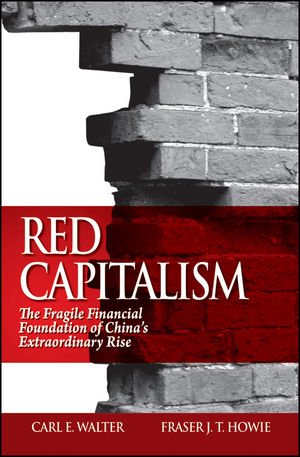


Red Capitalism: The Fragile Financial Foundation of China's Extraordinary Rise
In Red Capitalism, Carl Walter and Fraser Howie detail how the Chinese government reformed and modeled its financial system in the 30 years since it began its policy of engagement with the west. Instead of a stable series of policies producing steady growth, China's financial sector has boomed and gone bust with regularity in each decade. The latest decade is little different. Chinese banks have become objects of political struggle while they totter under balance sheets bloated by the excessive state-directed lending and bond issuance of 2009.
Looking forward, the government's response to the global financial crisis has created a banking system the stability of which can be maintained only behind the walls of a non-convertible currency, a myriad of off-balance sheet arrangements with non-public state entities and the strong support of its best borrowers--the politically potent National Champions--who are the greatest beneficiaries of the financial status quo.
China's financial system is not a model for the west and, indeed, is not a sustainable arrangement for China itself as it seeks increasingly to assert its influence internationally. This is not a story of impending collapse, but of frustrated reforms that suggests that any full opening and meaningful reform of the financial sector is not, indeed cannot be, on the government's agenda anytime soon.
Q&A with Authors Carl E. Walter and Fraser J. T. Howie
You have been writing together about the Chinese financial system for over a decade, what are the biggest changes you have seen?
The obvious one is just the shear size of the markets and the economy. At the time of the Asian Financial Crisis in 1997 China’s foreign reserves were about 150 billion US$. Now they are twenty times bigger. The number of listed companies has more than doubled, the daily trade volumes in Shanghai have increased ten-fold and only a handful of government bonds had been issued. Now there are thousands of different debt products. Everywhere you look the numbers just seem to get bigger and bigger, but that doesn’t tell the whole story. All the growth comes without the expected development: Chinese markets remain primitive in spite of their size.
How do the markets remain primitive? Surely the growth brought development?
China has done a fantastic job at building the market infrastructure. Trading and settlement systems and all that goes along with what we would call a modern market is there, but in nearly every case, the market has been warped or restricted by the government. Take the bond market, the government sets interest rates and even the rates at which bonds can be issued. No bond investor considers the possibility of default of the issuer because the assumption is that the government will step in to cover the risk. What then does a bond market do if credit risk and interest rate risk have been removed? In the stock market, the state still remains the largest holder of shares and has majority ownership of all the major companies. No one seriously expects the state to ever sell down their holdings, so the market doesn’t price companies but shares. The stock market fundamentally should be about pricing capital and companies, but since the state owns the companies, the market isn’t the place where company control and ownership are traded.
Has the entry of foreign investors, banks and brokers made a difference to the markets?
In a word, no. There have been a broad range of developments and programs to allow foreign capital into the domestic markets, but foreign onshore operations remain very small and tightly controlled. Foreign stock investors have only been allowed to invest less than 20 billion US$ into Chinese domestic stocks over the past decade; the foreign banks’ share of the banking market has fallen. Only now are we starting to see foreign capital get into the domestic bond market. China bulls point to this as progress and development, but the pace of change is glacial and the returns limited; foreigners hold only 1.77 percent of Chinese financial assets.
In Red Capitalism you focus on the banking sector. Why was that?
It is true that the restructuring of state enterprises in order to sell shares and raise capital has transformed China’s corporate sector. It is also the most glamorous area of finance. The truth, however, is that equity capital has provided in any given year less than 10 percent of all corporate capital raised. The real source of corporate finance in China was and remains the banks, which are the very heart of the entire system.
The Western financial system has been shown to be very imperfect, but does the Chinese model offer an alternative?
China’s bankers have said publicly that after the global financial crisis they no longer have a model to follow. The reason its banks emerged safely from the global turmoil is because they were walled off from it behind an inconvertible currency and tiny international credit exposures. In today’s world of global trade, banks must be more than simply purveyors of cheap capital to domestic companies. China’s banks have yet to reach out to assist its National Champions in their expansion overseas. So it is inaccurate to compare the two financial systems.
You talk about the fragile foundation of China’s rise, how do you think that will play out over the next twenty years? Will China become a superpower like America?
China’s weaknesses are very real and the problems will take a lot of determined effort to solve. Perhaps some of them can’t be solved without a break with the past, but we want to downplay the idea that collapse is imminent. The Chinese government is not getting rid of its currency controls any time soon, so they will be able to cushion the impact of any downturn reasonably well. The weakness of the system will play out through continual misallocation of capital and resources. Investment will follow political whim, resulting in tremendous waste and corruption. China will continue to grow and get bigger, so maybe the economy will be bigger than the states, but it will not be able to exert the same influence that the US can and will continue to do--unless the government embraces real reform across a broad spectrum of issues.


