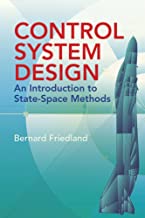


Control System Design: An Introduction to State-Space Methods (Dover Books on Electrical Engineering)
Book Details
Author(s)
Bernard Friedland
Publisher
Dover Publications
ISBN / ASIN
0486442780
ISBN-13
9780486442785
Availability
Usually ships in 24 hours
Sales Rank
#544,271
Category
Technology & Engineering
Marketplace
United States 🇺🇸
Ratings & Reviews
No reviews yet — be the first!
No reviews yet.
Description
Addressed not only to students but also to professional engineers and scientists, this volume introduces state-space methods for direct applications to control system design, in addition to providing background for reading the periodical literature. Its presentation, therefore, is suitable both for those who require methods for achieving results and those more interested in using results than in proving them.
Topics include feedback control; state-space representation of dynamic systems and dynamics of linear systems; frequency-domain analysis; controllability and observability; and shaping the dynamic response. Additional subjects encompass linear observers; compensator design by the separation principle; linear, quadratic optimum control; random processes; and Kalman filters.
Concrete examples of how state-space methods can be used to advantage in several representative applications are woven into the fabric of the text and the homework problems. Many of the models are drawn from aerospace and inertial instrumentation; other examples are derived from chemical process control, maritime operations, robotics, and energy systems.
Topics include feedback control; state-space representation of dynamic systems and dynamics of linear systems; frequency-domain analysis; controllability and observability; and shaping the dynamic response. Additional subjects encompass linear observers; compensator design by the separation principle; linear, quadratic optimum control; random processes; and Kalman filters.
Concrete examples of how state-space methods can be used to advantage in several representative applications are woven into the fabric of the text and the homework problems. Many of the models are drawn from aerospace and inertial instrumentation; other examples are derived from chemical process control, maritime operations, robotics, and energy systems.