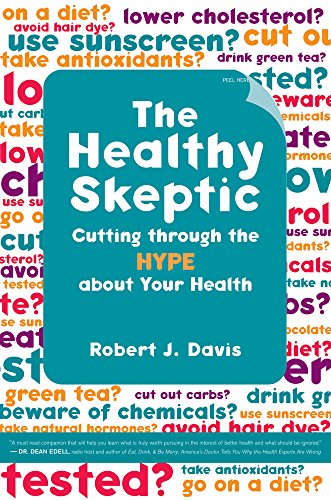


The Healthy Skeptic: Cutting through the Hype about Your Health
No reviews yet.
Amazon.com Exclusive
An Interview with Robert J. Davis, Ph.D
Amazon.com: What is a "healthy skeptic"?
Davis: A healthy skeptic is someone who takes time to critically evaluate all health advice, regardless of whether it comes from the media, a drug company, a non-profit health group, the government, or anyone else. We’re flooded with more information and advice than ever about how to stay healthy. While some of it is solid, much of it is misleading, and some is potentially harmful. Because prevention is so important--taking the right steps can greatly enhance our health and the quality of our lives--we can’t afford to let ourselves be swayed by spin.
Amazon.com: If a news article or TV ad touts the efficacy of a new drug based on "clinical trials" or "clinical testing," is this information reliable?
Davis: To be approved and marketed, prescription drugs must be subjected to rigorous clinical testing in humans. However, sometimes we see media reports hyping early-stage research on a drug--it killed cancer cells in a test-tube, for example, or reversed diabetes in rodents--and we’re led to believe that a cure is around the corner. In fact, preliminary findings such as these frequently don’t pan out upon further investigation. That’s why when we hear that "research shows" something, it’s important to know what kind of research we’re talking about: Is it an early-stage experiment testing only safety, for example, or a long-term randomized trial involving thousands of people? There’s a big difference.
The term "clinically proven" is often used misleadingly to promote herbal remedies and other dietary supplements. Unlike prescription drugs, supplements don’t have to undergo rigorous testing before they can be sold and marketed. Supplement manufacturers may conduct small, short-term, poorly designed experiments and point to them as "proof" that their products are safe and effective. And in some cases, the "clinical trials" cited by supplement makers involve a product that’s entirely different from the one being marketed.
Amazon.com: In your book you reveal some eye-opening revelations about specific kinds of products that most of us eat, apply or wear everyday, such a chocolate, vitamins, sunscreen, and cosmetics. Many of these products, like sunscreens, for example, even have seals of approval from important sounding medical organizations. Are these endorsements trustworthy?
Davis: In many cases, no. Product manufacturers typically pay non-profit health groups for their seals of approval, an arrangement that sets up a potential conflict of interest. Sometimes the requirements for earning a seal are so lax as to be practically meaningless. In other cases, a seal is offered exclusively to one company or a limited number of companies. The result is the misleading implication that the product(s) carrying the seal are superior to all those without it. Despite considerable criticism of this practice, it continues because it produces revenue for health groups and provides marketing benefits to companies.
Amazon.com: Why should citizens be concerned about the funding sources of scientific research?
Davis: Increasingly, studies are funded by groups such as drug companies, food producers, dietary supplement manufacturers, or consumer activists, which have a vested interest in the outcome. Such sponsorship doesn’t necessarily mean the research is biased or invalid, but it does at least raise the possibility that the study'smethods or conclusions were directly or indirectly influenced by the funder's agenda. Most researchers will tell you that the funding source has no influence on their findings--and in many cases that's true. But various analyses have shown that industry-funded research is more likely to produce results favorable to the funder than research not funded by industry. One possible explanation is that industry-funded research that is unfavorable to the funder may be buried and never published. Also, industry funders of research tends to gravitate toward scientists who seem likely, based on their previous research and opinions, to reach conclusions consistent with the funder's aims. While such sponsorship is essential--it allows scientists to conduct valuable studies that may not otherwise be possible--we need to take it into account when interpreting research findings.
Amazon.com: Can you give an example of a commonly encountered health claim or rule of thumb that is overstated or oversimplified? What alternative wording would be more accurate?
Davis: One that we hear all the time is that sunscreen protects against skin cancer. That's actually only partially true. Sunscreen has been shown to protect against a (generally) non-lethal form of skin cancer known as squamous cell cancer. But when it comes to melanoma--the type that’s most often deadly-- the jury is still out. Yet, we often are told by various health promoters (including some who receive funding from the sunscreen industry) that sunscreen is a proven protector and should be a first line of defense against all forms of skin cancer. In fact, staying out of the sun, wearing a hat, and covering up are the best ways to protect yourself. Sunscreen should be a second line of defense.
Amazon.com: In "The Healthy Skeptic" you cast a pretty critical eye on your own profession--health journalism. Why is that? And, what kinds of changes in health reporting would you like to see?
Davis: According to surveys, what we learn about health--especially prevention--tends to come mainly from the news media. Too often, this information is incomplete, oversimplified, and devoid of context. One problem, of course, is a lack of time and space; there’s only so much that even the best health journalist can squeeze into a 100-word news brief or a 20-second TV clip. But there’s also a larger issue: a fundamental difference between science and journalism. Science involves small, incremental steps that gradually get us closer to the truth. Journalism, in contrast, is largely about what is new, interesting, and attention grabbing. When journalists present health research through this prism, as is often the case, we can get a distorted sense of reality.
In talks to health journalists, I encourage them to focus more on the big picture. For example, if a particular study shows coffee is bad (or good) for us, how does this square with previous research? Is the study more or less believable than what came before? And how does the risk (or benefit) stack up against others? Is it large enough, in practical terms for us to really care about it? Such information is key to making informed decisions.
Amazon.com: What can we as consumers do to "separate belief from facts"? What are some trusted resources that the average time-strapped person might tap into for a reality check on the latest health hype?
Davis: In my book I list some superb resources that provide straightforward, spin-free information. For example, if you’re seeking the truth about a particular herb or other dietary supplement, both Consumer Reports and the Mayo Clinic Website offer comprehensive databases that have detailed information about safety and effectiveness. Or if your concern is food and nutrition, the Harvard School of Public Health has a terrific Web site, called Nutrition Source, and there are several excellent health letters, including Nutrition Action and the Tufts Health and Nutrition Letter, which set the record straight.
In surveys asking what is most important, respondents typically put their health at or near the top of the list. If we really mean that, it's certainly worth spending a little extra time and effort to check out the health advice and information we're getting.
Amazon.com: Is it possible to be a healthy skeptic without turning into neurotic worry wart?
Davis: Absolutely. In fact, being a healthy skeptic is the antidote to being worry wart. Every day, we’re warned about something--foods, beverages, pesticides, plastics, cell phones, hair dye, Teflon pans and on and on--that allegedly threatens our health and our lives. Trying to heed all or even most of these warnings can be overwhelming. There is, after all, only so much that we can worry about. A healthy skeptic learns to look at each alleged threat in context, asking a) how solid is the evidence? and b) how big is the risk compared to other, well-established risks (such as smoking)? As a result, we’re able to prioritize, focusing mainly on those measures that are most likely to have the biggest impact. Being a health skeptic entails maintaining perspective so that we don’t get carried away with our pursuit of health, and in the process, cause ourselves psychological harm.