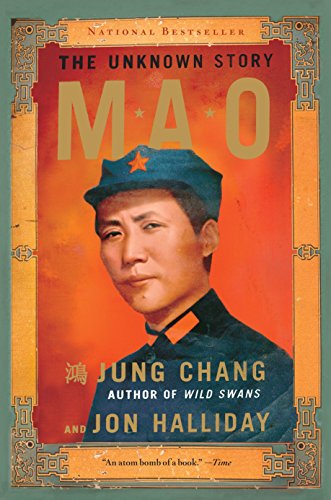


Mao: The Unknown Story
No reviews yet.
Using exhaustive research in archives all over the world, Chang and Halliday recast Mao's ascent to power and subsequent grip on China in the context of global events. Sino-Soviet relations, the strengths and weakness of Chiang Kai-shek, the Japanese invasion of China, World War II, the Korean War, the disastrous Great Leap Forward, the vicious Cultural Revolution, the Vietnam War, Nixon's visit, and the constant, unending purges all, understandably, provide the backdrop for Mao's unscrupulous but invincible political maneuverings and betrayals. No one escaped unharmed. Rivals, families, peasants, city dwellers, soldiers, and lifelong allies such as Chou En-lai were all sacrificed to Mao's ambition and paranoia. Appropriately, the authors' consciences are appalled. Their biggest fear is that Mao will escape the global condemnation and infamy he deserves. Their astonishing book will go a long way to ensure that the pendulum of history will adjust itself accordingly. --Silvana Tropea
Q: From idea to finished book, how long did Mao: The Unknown Story take to research and write?
A: Over a decade.
Q: What was your writing process like? How did you two collaborate on this project?
A: The research shook itself out by language. Jung did all the Chinese-language research, and Jon did the other languages, of which Russian was the most important, as Mao had a long-term intimate relationship with Stalin. After our research trips around the world, we would work in our separate studies in London. We would then rendezvous at lunch to exchange discoveries.
Q: Do you have any thoughts about how the book is, or will be received in China? Did that play a part in your writing of the book?
A: The book is banned in China, because the current Communist regime is fiercely perpetuating the myth of Mao. Today Mao's portrait and his corpse still dominate Tiananmen Square in the heart of Beijing, and the regime declares itself to be Mao's heir. The government blocked the distribution of an issue of The Far Eastern Economic Review, and told the magazine's owners, Dow Jones, that this was because that issue contained a review of our book. The regime also tore the review of our book out of The Economist magazine that was going to (very restricted) newsstands. We are not surprised that the book is banned. The regime's attitude had no influence on how we wrote the book. We hope many copies will find their way into China.
Q: What is the one thing you hope readers get from your book?
A: Mao was responsible for the deaths of well over 70 million Chinese in peacetime, and he was bent on dominating the world. As China is today emerging as an economic and military power, the world can never regard it as a benign force unless Beijing rejects Mao and all his legacies. We hope our book will help push China in this direction by telling the truth about Mao.
1. Mao became a Communist at the age of 27 for purely pragmatic reasons: a job and income from the Russians.
2. Far from organizing the Long March in 1934, Mao was nearly left behind by his colleagues who could not stand him and had tried to oust him several times. The aim of the March was to link up with Russia to get arms. The Reds survived the March because Chiang Kai-shek let them, in a secret horse-trade for his son and heir, whom Stalin was holding hostage in Russia.
3. Mao grew opium on a large scale.
4. After he conquered China, Mao's over-riding goal was to become a superpower and dominate the world: "Control the Earth," as he put it.
5. Mao caused the greatest famine in history by exporting food to Russia to buy nuclear and arms industries: 38 million people were starved and slave-driven to death in 1958-61. Mao knew exactly what was happening, saying: "half of China may well have to die."

