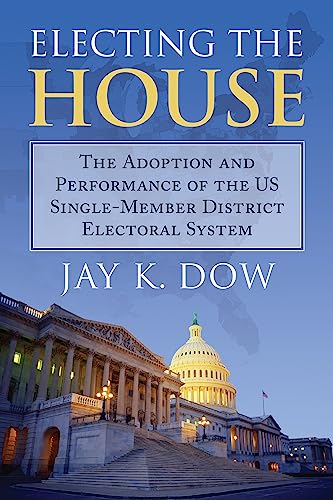


Electing the House: The Adoption and Performance of the U.S. Single-Member District Electoral System
27.95
USD
Book Details
Author(s)
Jay K. Dow,
Publisher
University Press of Kansas
ISBN / ASIN
0700624104
ISBN-13
9780700624102
Sales Rank
#850,277
Category
History
Marketplace
United States 🇺🇸
Description
In the United States we elect members of the House of Representative from single-member districts: the candidate who receives the most votes from each geographically defined district wins a seat in the House. This system—so long in place that it seems perfectly natural—is, however, unusual. Most countries use proportional representation to elect their legislatures. Electing the House is the first book-length study to explore how the US came to adopt the single-member district system, how it solidified into a seemingly permanent fixture of American government and whether it performs well by the standards it was intended to achieve.
The US Constitution grants the states the authority to elect representatives in a manner of their own choosing, subject to restrictions that Congress might impose. Electing the House reminds us that in the nation’s early years the states exercised this privilege and elected their representatives using a variety of methods. Dow traces the general adoption of the present system to the Jacksonian Era—specifically to the major franchise expansion and voter mobilization of the time. The single-member district plurality-rule system was the Federalists’ solution to tyranny of the majority under the expectation of universal franchise, and the Jacksonian-Whigs–Era response to the political uncertainty caused by large-scale voter mobilization. The system was solidified concurrently with the enfranchisement of women in the early twentieth century and African Americans in the Civil Rights Era. Dow persuasively argues that the single-member district system became the way that we elect our representatives because it fits especially well within the corpus of political thought that informs our collective understanding of good governance and it performs well by the standards it was meant to achieve, and these standards are still relevant today.
Locating the development of single-member district system within the context of American political thought, Dow's study clarifies the workings and the significance of a critical electoral process in our time. In the process, the book informs and enhances our understanding of the evolution of the American political system.
The US Constitution grants the states the authority to elect representatives in a manner of their own choosing, subject to restrictions that Congress might impose. Electing the House reminds us that in the nation’s early years the states exercised this privilege and elected their representatives using a variety of methods. Dow traces the general adoption of the present system to the Jacksonian Era—specifically to the major franchise expansion and voter mobilization of the time. The single-member district plurality-rule system was the Federalists’ solution to tyranny of the majority under the expectation of universal franchise, and the Jacksonian-Whigs–Era response to the political uncertainty caused by large-scale voter mobilization. The system was solidified concurrently with the enfranchisement of women in the early twentieth century and African Americans in the Civil Rights Era. Dow persuasively argues that the single-member district system became the way that we elect our representatives because it fits especially well within the corpus of political thought that informs our collective understanding of good governance and it performs well by the standards it was meant to achieve, and these standards are still relevant today.
Locating the development of single-member district system within the context of American political thought, Dow's study clarifies the workings and the significance of a critical electoral process in our time. In the process, the book informs and enhances our understanding of the evolution of the American political system.