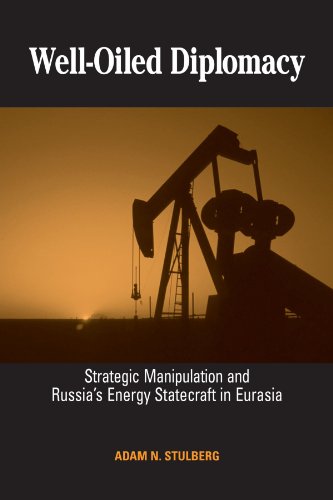


Well-Oiled Diplomacy: Strategic Manipulation and Russia's Energy Statecraft in Eurasia (Suny Series in Global Politics)
Book Details
Author(s)
Adam N. Stulberg
Publisher
State University of New York Press
ISBN / ASIN
0791470644
ISBN-13
9780791470640
Availability
Usually ships in 24 hours
Sales Rank
#2,198,058
Category
History
Marketplace
United States 🇺🇸
Ratings & Reviews
No reviews yet — be the first!
No reviews yet.
Description
Examines Russia s energy policy with rival Eurasian supplier states from 1992 to 2002.
As a window into understanding the relationship between globalization and the pursuit of national security, Adam N. Stulberg examines Russia s mixed success at leveraging energy advantages in Eurasia from 1992 to 2002. Stulberg supplements traditional analyses of statecraft by highlighting indirect market and regulatory mechanisms for altering the behavior of foreign and subnational actors, as well as by demonstrating the usability of soft power and global networks. The power of this new theory of strategic manipulation is illustrated in several case studies, including Russia s successful natural gas diplomacy toward Turkmenistan and Kazakhstan, Russia s troubled oil diplomacy toward Azerbaijan and Kazakhstan, and Russia s mixed success with commercial nuclear diplomacy toward Kyrgyzstan and Kazakhstan.
This is a well-researched and useful book. It takes a subtle theoretical approach that offers greater insight into economic statecraft Furthermore, its empirical contributions on several vital subjects including soft power, energy policy, and Russian behavior in the Caspian region will provide a trove for researchers for years . It will be a lasting contribution to the study of Russian energy policy and of economic statecraft more generally. Political Science Quarterly
This superb new study goes beyond explanations of statecraft that rely exclusively on market position, domestic institutional structure, and/or coercive manipulation of hard power. Not only does Well-Oiled Diplomacy refine our understanding of how and why each of these factors matters, but it also enlarges our theoretical sophistication by elucidating the importance of framing alternative options and manipulating the distance between them. In this way, too, it augments formal (rationalist) models of strategic interaction by incorporating risk alongside standard variables of information symmetry and cost-benefit calculations of expected utility. And finally, by identifying the critical role of discrete regulatory capacity, it strengthens our knowledge of the relationship between domestic structure and international politics. Scholars will be deeply indebted to Stulberg for all of these reasons. Doug Blum, Providence College
As a window into understanding the relationship between globalization and the pursuit of national security, Adam N. Stulberg examines Russia s mixed success at leveraging energy advantages in Eurasia from 1992 to 2002. Stulberg supplements traditional analyses of statecraft by highlighting indirect market and regulatory mechanisms for altering the behavior of foreign and subnational actors, as well as by demonstrating the usability of soft power and global networks. The power of this new theory of strategic manipulation is illustrated in several case studies, including Russia s successful natural gas diplomacy toward Turkmenistan and Kazakhstan, Russia s troubled oil diplomacy toward Azerbaijan and Kazakhstan, and Russia s mixed success with commercial nuclear diplomacy toward Kyrgyzstan and Kazakhstan.
This is a well-researched and useful book. It takes a subtle theoretical approach that offers greater insight into economic statecraft Furthermore, its empirical contributions on several vital subjects including soft power, energy policy, and Russian behavior in the Caspian region will provide a trove for researchers for years . It will be a lasting contribution to the study of Russian energy policy and of economic statecraft more generally. Political Science Quarterly
This superb new study goes beyond explanations of statecraft that rely exclusively on market position, domestic institutional structure, and/or coercive manipulation of hard power. Not only does Well-Oiled Diplomacy refine our understanding of how and why each of these factors matters, but it also enlarges our theoretical sophistication by elucidating the importance of framing alternative options and manipulating the distance between them. In this way, too, it augments formal (rationalist) models of strategic interaction by incorporating risk alongside standard variables of information symmetry and cost-benefit calculations of expected utility. And finally, by identifying the critical role of discrete regulatory capacity, it strengthens our knowledge of the relationship between domestic structure and international politics. Scholars will be deeply indebted to Stulberg for all of these reasons. Doug Blum, Providence College