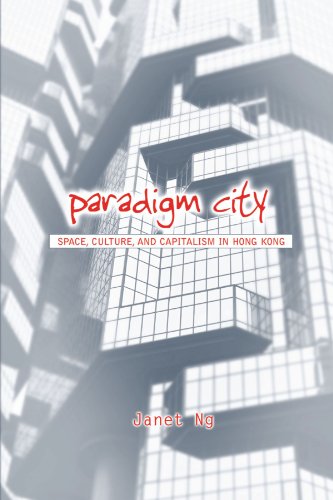


Paradigm City: Space, Culture, and Capitalism in Hong Kong (SUNY Series in Global Modernity)
Book Details
Author(s)
Janet Ng
Publisher
State University of New York Press
ISBN / ASIN
0791476669
ISBN-13
9780791476666
Availability
Usually ships in 24 hours
Sales Rank
#4,481,873
Category
History
Marketplace
United States 🇺🇸
Description
Materially grounded analysis of contemporary film, literature, and music in Hong Kong that resists the superficial stereotypes of the “global city.â€
Hong Kong is often cast in the role of the paradigmatic “global city,†epitomizing postmodernism and globalization, and representing a vision of a cosmopolitan global and capitalist future. In Paradigm City, Janet Ng takes us past the obsession with 1997—the year of Hong Kong’s return to China—to focus on the complex uses and meanings of urban space in Hong Kong in the period following that transfer. She demonstrates how the design and ordering of the city’s space and the practices it supports inculcates a particular civic aesthetic among Hong Kong’s population that corresponds to capitalist as well as nationalist ideologies. Ng’s insightful connections between contemporary film, literature, music and other media and the actual spaces of the city—such as parks, shopping malls, and domestic spaces—provide a rich and nuanced picture of Hong Kong today.
“…Paradigm City is pleasant reading and conveys quite comprehensively the complex socio-political dynamics of a city that has yet to find a clear identity in the midst of a seemingly never-ending transition.†— China Journal
“…covers much in a quite interesting way.†— CHOICE
Hong Kong is often cast in the role of the paradigmatic “global city,†epitomizing postmodernism and globalization, and representing a vision of a cosmopolitan global and capitalist future. In Paradigm City, Janet Ng takes us past the obsession with 1997—the year of Hong Kong’s return to China—to focus on the complex uses and meanings of urban space in Hong Kong in the period following that transfer. She demonstrates how the design and ordering of the city’s space and the practices it supports inculcates a particular civic aesthetic among Hong Kong’s population that corresponds to capitalist as well as nationalist ideologies. Ng’s insightful connections between contemporary film, literature, music and other media and the actual spaces of the city—such as parks, shopping malls, and domestic spaces—provide a rich and nuanced picture of Hong Kong today.
“…Paradigm City is pleasant reading and conveys quite comprehensively the complex socio-political dynamics of a city that has yet to find a clear identity in the midst of a seemingly never-ending transition.†— China Journal
“…covers much in a quite interesting way.†— CHOICE