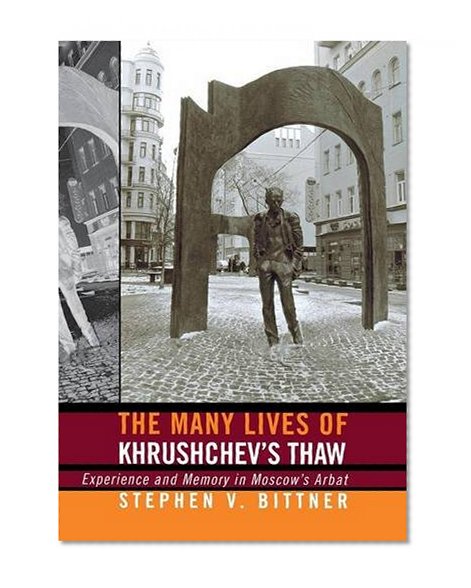


The Many Lives of Khrushchev's Thaw: Experience and Memory in Moscow's Arbat
Book Details
Description
The Arbat neighborhood in central Moscow has long been home to many of Russia's most famous artists, writers, and scholars, as well as several of its leading cultural establishments. In an elegantly written and evocative portrait of a unique urban space at a time of transition, Stephen V. Bittner explores how the neighborhood changed during the period of ideological relaxation under Khrushchev that came to be known as the thaw.
The thaw is typically remembered as a golden age, a period of artistic rebirth and of relatively free expression after decades of Stalinist repression. By considering events at the Vakhtangov Theater, the Gnesin Music-Pedagogy Institute, the Union of Architects, and the Institute of World Literature, Bittner finds that the thaw was instead characterized by much confusion and contestation. As political strictures loosened after Stalin's death, cultural figures in the Arbat split often along generational lines over the parameters of reform and over the amount of freedom of expression now permitted.
De-Stalinization provoked great anxiety because its scope was often unclear. Particularly in debates about Khrushchev's urban-planning initiatives, which involved demolishing a part of the historical Arbat to build an ensemble of concrete-and-steel high rises, a conflict emerged over what aspects of the Russian past should be prized in memory: the late tsarist city, the utopian modernism of the early Soviet period, or the neoclassical and gothic structures of Stalinism. Bittner's book is a window onto the complex beginning of a process that is not yet complete: deciding what to jettison and what to retain from the pre-Soviet and Soviet pasts as a new Russia moves to the future.
