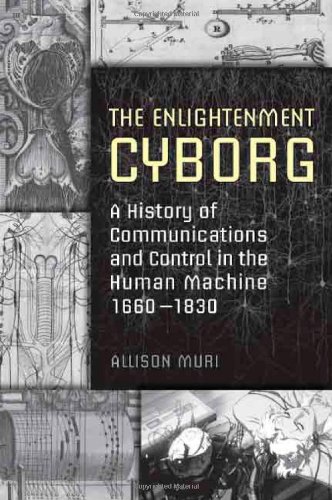


The Enlightenment Cyborg: A History of Communications and Control in the Human Machine, 1660-1830
Book Details
Description
For many cultural theorists, the concept of the cyborg - an organism controlled by mechanic processes - is firmly rooted in the post-modern, post-industrial, post-Enlightenment, post-nature, post-gender, or post-human culture of the late twentieth century. Allison Muri argues, however, that there is a long and rich tradition of art and philosophy that explores the equivalence of human and machine, and that the cybernetic organism as both a literary figure and an anatomical model has, in fact, existed since the Enlightenment.
In The Enlightenment Cyborg, Muri presents cultural evidence - in literary, philosophical, scientific, and medical texts - for the existence of mechanically steered, or 'cyber' humans in the works seventeenth- and eighteenth-century thinkers. Muri illustrates how Enlightenment exploration of the notion of the 'man-machine' was inextricably tied to ideas of reproduction, government, individual autonomy, and the soul, demonstrating an early connection between scientific theory and social and political thought. She argues that late twentieth-century social and political movements, such as socialism, feminism, and even conservatism, are thus not unique in their use of the cyborg as a politicized trope.
The Enlightenment Cyborg establishes a dialogue between eighteenth-century studies and cyborg art and theory, and makes a significant and original contribution to both of these fields of inquiry.
More Books in History