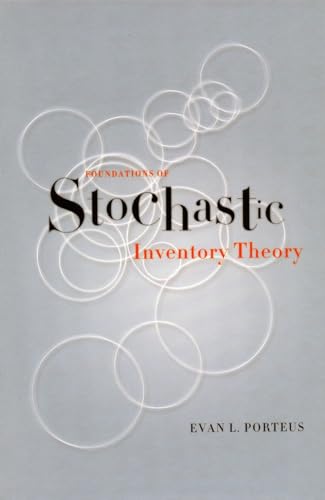


Foundations of Stochastic Inventory Theory (Stanford Business Books)
Book Details
Author(s)
Evan Porteus
Publisher
Stanford Business Books
ISBN / ASIN
0804743991
ISBN-13
9780804743990
Availability
Usually ships in 24 hours
Sales Rank
#1,197,083
Category
Business & Economics
Marketplace
United States 🇺🇸
Ratings & Reviews
No reviews yet — be the first!
No reviews yet.
Description
In 1958, Stanford University Press published Studies in the Mathematical Theory of Inventory and Production (edited by Kenneth J. Arrow, Samuel Karlin, and Herbert Scarf), which became the pioneering road map for the next forty years of research in this area. One of the outgrowths of this research was development of the field of supply-chain management, which deals with the ways organizations can achieve competitive advantage by coordinating the activities involved in creating products including designing, procuring, transforming, moving, storing, selling, providing after-sales service, and recycling. Following in this tradition, Foundations of Stochastic Inventory Theory has a dual purpose, serving as an advanced textbook designed to prepare doctoral students to do research on the mathematical foundations of inventory theory and as a reference work for those already engaged in such research. The author begins by presenting two basic inventory models: the economic order quantity model, which deals with "cycle stocks," and the newsvendor model, which deals with "safety stocks." He then describes foundational concepts, methods, and tools that prepare the reader to analyze inventory problems in which uncertainty plays a key role. Dynamic optimization is an important part of this preparation, which emphasizes insights gained from studying the role of uncertainty, rather than focusing on the derivation of numerical solutions and algorithms (with the exception of two chapters on computational issues in infinite-horizon models). All fourteen chapters in the book, and four of the five appendixes, conclude with exercises that either solidify or extend the concepts introduced. Some of these exercises have served as Ph.D. qualifying examination questions in the Operations, Information, and Technology area of the Stanford Graduate School of Business.