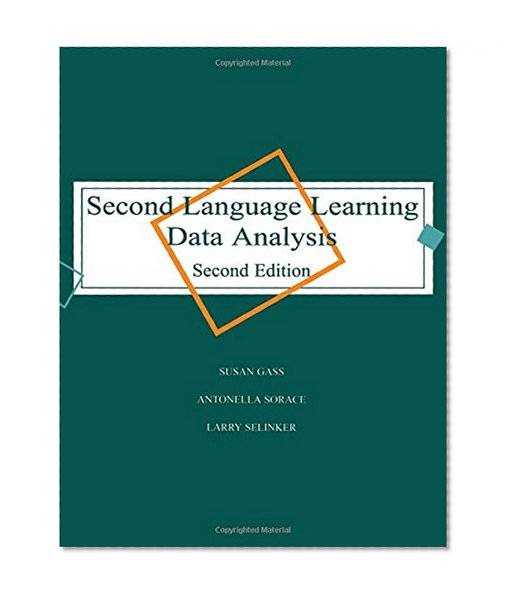


Second Language Learning Data Analysis: Second Edition (Volume 1)
Book Details
PublisherRoutledge
ISBN / ASIN0805832637
ISBN-139780805832631
AvailabilityIn stock. Usually ships within 2 to 3 days.
Sales Rank2,566,615
CategoryLanguage Arts & Disciplines
MarketplaceUnited States 🇺🇸
Description
The purpose of this workbook is to provide students with practice in analyzing second language data. For the student of second language learning, "hands-on" experience with actual data is essential in understanding the processes involved in learning a second language. Working through exemplars of the kinds of interlanguages that learners do and do not create brings about a clearer understanding of the principles underlying these interlanguages, as well as the universal principles of language learning (those that are independent of particular languages and interlanguages).
The goal in this workbook is to present data organized in such a way that by working through pedagogically presented data-sets, students are led to a discovery and understanding of theoretical and/or methodological issues. In addition, they acquire the ability to interpret data and to begin to draw conclusions from them. The authors intend that students should go from the data to a conclusion that includes a 3-part statement:
*what else you should want to know about these data;
*why this, specifically, and not something else; and
*how one can empirically research what you want to find out.
This sequence of questions forces students to constantly keep in mind the important question of falsification: What kind of data would it take to falsify the particular conclusions the students come to?
As with the earlier edition of this workbook (Sorace, Gass, & Selinker), two audiocassettes provide language samples for use in the exercises. These cassettes and the teacher's manual are offered free of charge on adoption of the workbook for classroom use; a three-part set (workbook/manual/tapes) is also available.
The goal in this workbook is to present data organized in such a way that by working through pedagogically presented data-sets, students are led to a discovery and understanding of theoretical and/or methodological issues. In addition, they acquire the ability to interpret data and to begin to draw conclusions from them. The authors intend that students should go from the data to a conclusion that includes a 3-part statement:
*what else you should want to know about these data;
*why this, specifically, and not something else; and
*how one can empirically research what you want to find out.
This sequence of questions forces students to constantly keep in mind the important question of falsification: What kind of data would it take to falsify the particular conclusions the students come to?
As with the earlier edition of this workbook (Sorace, Gass, & Selinker), two audiocassettes provide language samples for use in the exercises. These cassettes and the teacher's manual are offered free of charge on adoption of the workbook for classroom use; a three-part set (workbook/manual/tapes) is also available.
More Books in Language Arts & Disciplines