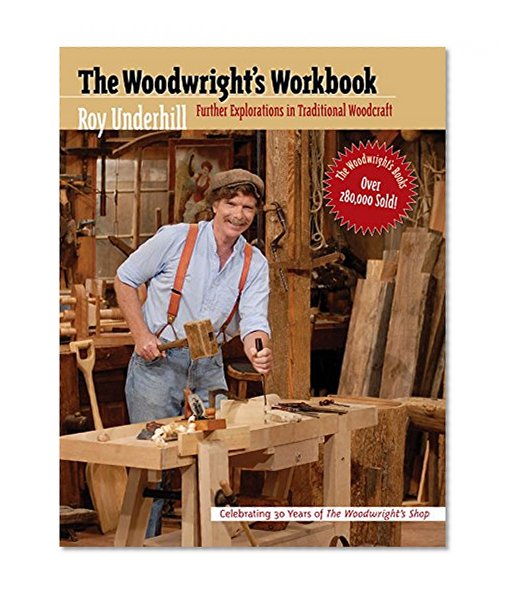


The Woodwright's Workbook: Further Explorations in Traditional Woodcraft
Book Details
Author(s)
Roy Underhill
Publisher
The University of North Carolina Press
ISBN / ASIN
0807841579
ISBN-13
9780807841570
Availability
Usually ships in 24 hours
Sales Rank
#393,777
Category
Crafts & Hobbies
Marketplace
United States 🇺🇸
Ratings & Reviews
No reviews yet — be the first!
No reviews yet.
Description
Roy Underhill is America's best-known master of traditional woodcraft. Creator of the popular PBS series The Woodwright's Shop, Roy has inspired millions--from professional craftsman to armchair woodworker--with his talent, knowledge, and enthusiasm.
Roy returns here with his third book. The Woodwright's Workbook features step-by-step instructions for a selection of projects from his television series. All projects are illustrated with photographs and measured drawings. Included here are plans for tool chests, workbenches, lathes, and historical reproductions of items for the home: a six-board chest, rustic chairs with cattail seats, a churn for the kitchen, and the Rittenhouse hygrometer. Roy also explores building barns, forges, boats, and even colonial fortresses.
A wonderful feature of this book is Roy's own translation of the humorous fifteenth-century poem The Debate of the Carpenter's Tools. He also provides a fascinating and useful 'field guide' to American tool marks that shows how to identify the specific tool used by the marks it left. Whether Roy is an old friend or a new acquaintance, let him be your guide to the world of traditional woodworking.
Roy returns here with his third book. The Woodwright's Workbook features step-by-step instructions for a selection of projects from his television series. All projects are illustrated with photographs and measured drawings. Included here are plans for tool chests, workbenches, lathes, and historical reproductions of items for the home: a six-board chest, rustic chairs with cattail seats, a churn for the kitchen, and the Rittenhouse hygrometer. Roy also explores building barns, forges, boats, and even colonial fortresses.
A wonderful feature of this book is Roy's own translation of the humorous fifteenth-century poem The Debate of the Carpenter's Tools. He also provides a fascinating and useful 'field guide' to American tool marks that shows how to identify the specific tool used by the marks it left. Whether Roy is an old friend or a new acquaintance, let him be your guide to the world of traditional woodworking.