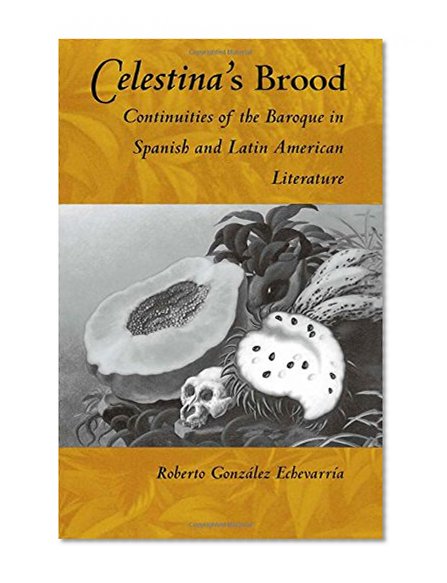


Celestina's Brood: Continuities of the Baroque in Spanish and Latin American Literature
Book Details
Author(s)Roberto González EchevarrÃa
PublisherDuke University Press Books
ISBN / ASIN0822313715
ISBN-139780822313717
AvailabilityUsually ships in 1 to 3 weeks
Sales Rank2,154,394
MarketplaceUnited States 🇺🇸
Description
Published in 1499 and centered on the figure of a bawd and witch, Fernando de Rojas' dark and disturbing Celestina was destined to become the most suppressed classic in Spanish literary history. Routinely ignored in Spanish letters, the book nonetheless echoes through contemporary Spanish and Latin American literature. This is the phenomenon that Celestina's Brood explores.
Roberto González EchevarrÃa, one of the most eminent and influential critics of Hispanic literature writing today, uses Rojas' text as his starting point to offer an exploration of modernity in the Hispanic literary tradition, and of the Baroque as an expression of the modern. His analysis of Celestina reveals the relentless probing of the limits of language and morality that mark the work as the beginning of literary modernity in Spanish, and the start of a tradition distinguished by a penchant for the excesses of the Baroque. González EchevarrÃa pursues this tradition and its meaning through the works of major figures such as Cervantes, Lope de Vega, Calderón de la Barca, Alejo Carpentier, Carlos Fuentes, Gabriel GarcÃa Márquez, Nicolás Guillén, and Severo Sarduy, as well as through the works of lesser-known authors.
By revealing continuities of the Baroque, Celestina's Brood cuts across conventional distinctions between Spanish and Latin American literary traditions to show their profound and previously unimagined affinity.
Roberto González EchevarrÃa, one of the most eminent and influential critics of Hispanic literature writing today, uses Rojas' text as his starting point to offer an exploration of modernity in the Hispanic literary tradition, and of the Baroque as an expression of the modern. His analysis of Celestina reveals the relentless probing of the limits of language and morality that mark the work as the beginning of literary modernity in Spanish, and the start of a tradition distinguished by a penchant for the excesses of the Baroque. González EchevarrÃa pursues this tradition and its meaning through the works of major figures such as Cervantes, Lope de Vega, Calderón de la Barca, Alejo Carpentier, Carlos Fuentes, Gabriel GarcÃa Márquez, Nicolás Guillén, and Severo Sarduy, as well as through the works of lesser-known authors.
By revealing continuities of the Baroque, Celestina's Brood cuts across conventional distinctions between Spanish and Latin American literary traditions to show their profound and previously unimagined affinity.
More Books by Roberto González EchevarrÃa


