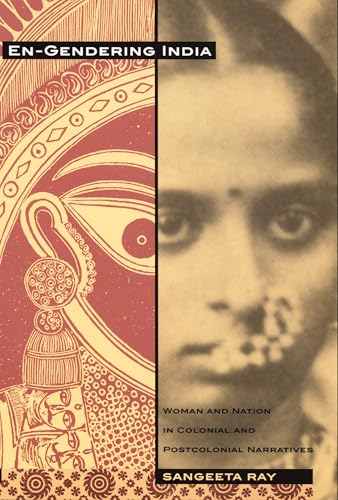


En-Gendering India: Woman and Nation in Colonial and Postcolonial Narratives
Book Details
Author(s)
Sangeeta Ray
Publisher
Duke University Press Books
ISBN / ASIN
0822324903
ISBN-13
9780822324904
Availability
Usually ships in 24 hours
Sales Rank
#3,202,996
Category
History
Marketplace
United States 🇺🇸
Ratings & Reviews
No reviews yet — be the first!
No reviews yet.
Description
En-Gendering India offers an innovative interpretation of the role that gender played in defining the Indian state during both the colonial and postcolonial eras. Focusing on both British and Indian literary texts primarily novels produced between 1857 and 1947, Sangeeta Ray examines representations of "native" Indian women and shows how these representations were deployed to advance notions of Indian self-rule as well as to defend British imperialism.
Through her readings of works by writers including Bankimchandra Chatterjee, Rabindranath Tagore, Harriet Martineau, Flora Annie Steel, Anita Desai, and Bapsi Sidhaa, Ray demonstrates that Indian women were presented as upper class and Hindu, an idealization that paradoxically served the needs of both colonial and nationalist discourses. The Indian nation s goal of self-rule was expected to enable women s full participation in private and public life. On the other hand, British colonial officials rendered themselves the protectors of passive Indian women against their savage male countrymen. Ray shows how the native woman thus became a symbol for both an incipient Indian nation and a fading British Empire. In addition, she reveals how the figure of the upper-class Hindu woman created divisions with the nationalist movement itself by underscoring caste, communal, and religious differences within the newly emerging state. As such, Ray s study has important implications for discussions about nationalism, particularly those that address the concepts of identity and nationalism.
Building on recent scholarship in feminism and postcolonial studies, En-Gendering India will be of interest to scholars in those fields as well as to specialists in nationalism and nation-building and in Victorian, colonial, and postcolonial literature and culture.
Through her readings of works by writers including Bankimchandra Chatterjee, Rabindranath Tagore, Harriet Martineau, Flora Annie Steel, Anita Desai, and Bapsi Sidhaa, Ray demonstrates that Indian women were presented as upper class and Hindu, an idealization that paradoxically served the needs of both colonial and nationalist discourses. The Indian nation s goal of self-rule was expected to enable women s full participation in private and public life. On the other hand, British colonial officials rendered themselves the protectors of passive Indian women against their savage male countrymen. Ray shows how the native woman thus became a symbol for both an incipient Indian nation and a fading British Empire. In addition, she reveals how the figure of the upper-class Hindu woman created divisions with the nationalist movement itself by underscoring caste, communal, and religious differences within the newly emerging state. As such, Ray s study has important implications for discussions about nationalism, particularly those that address the concepts of identity and nationalism.
Building on recent scholarship in feminism and postcolonial studies, En-Gendering India will be of interest to scholars in those fields as well as to specialists in nationalism and nation-building and in Victorian, colonial, and postcolonial literature and culture.