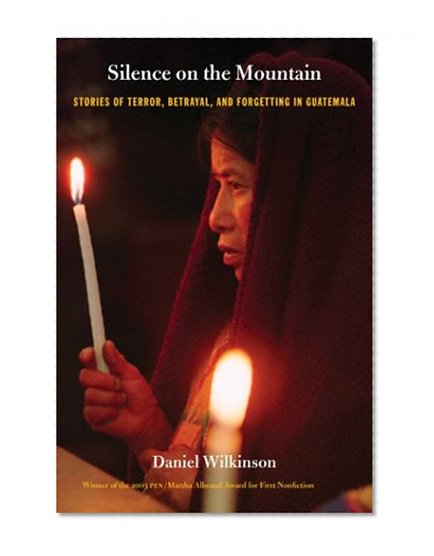


Silence on the Mountain: Stories of Terror, Betrayal, and Forgetting in Guatemala (American Encounters/Global Interactions)
Book Details
Author(s)
Daniel Wilkinson
Publisher
Duke University Press Books
ISBN / ASIN
0822333686
ISBN-13
9780822333685
Availability
Usually ships in 24 hours
Sales Rank
#498,365
Category
History
Marketplace
United States 🇺🇸
Ratings & Reviews
No reviews yet — be the first!
No reviews yet.
Description
new in paperback
Silence on the Mountain is a virtuoso work of reporting and a masterfully plotted narrative tracing the history of Guatemala’s thirty-six-year internal war, a conflict that claimed the lives of some 200,000 people, the vast majority of whom died (or were “disappeared”) at the hands of the U.S.-backed military government. Written by Daniel Wilkinson, a young human rights worker, the story begins in 1993, when the author decides to investigate the arson of a coffee plantation’s manor house by a band of guerrillas. The questions surrounding this incident soon broaden into a complex mystery whose solution requires Wilkinson to dig up the largely unwritten history of the country’s recent civil war, following its roots back to a land reform movement that was derailed by a U.S.-sponsored military coup in 1954 and to the origins of a plantation system that put Guatemala’s Mayan Indians to work picking coffee beans for the American and European markets.
Silence on the Mountain is a virtuoso work of reporting and a masterfully plotted narrative tracing the history of Guatemala’s thirty-six-year internal war, a conflict that claimed the lives of some 200,000 people, the vast majority of whom died (or were “disappeared”) at the hands of the U.S.-backed military government. Written by Daniel Wilkinson, a young human rights worker, the story begins in 1993, when the author decides to investigate the arson of a coffee plantation’s manor house by a band of guerrillas. The questions surrounding this incident soon broaden into a complex mystery whose solution requires Wilkinson to dig up the largely unwritten history of the country’s recent civil war, following its roots back to a land reform movement that was derailed by a U.S.-sponsored military coup in 1954 and to the origins of a plantation system that put Guatemala’s Mayan Indians to work picking coffee beans for the American and European markets.
Decades of terror-inspired fear have led the Guatemalans to adopt a survival strategy of silence so complete it verges on collective amnesia. The author’s great triumph is that he finds a way for people to tell their stories, and it is through these stories—dramatic, intimate, heartbreaking—that we are shown the anatomy of a thwarted revolution that has relevance not only to Guatemala but also to countless places around the world where terror has been used as a political tool.