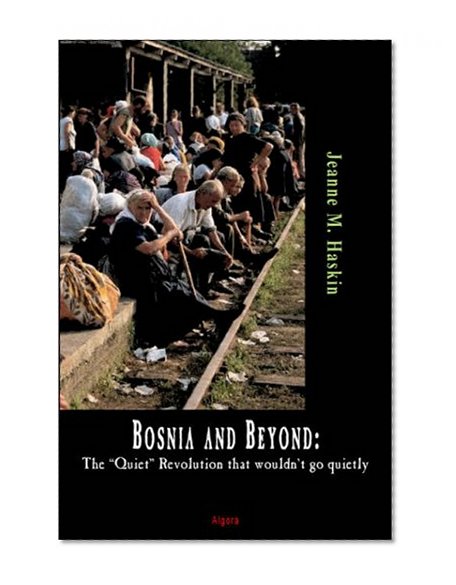


Bosnia And Beyond: The "Quiet" Revolution That Wouldn't Go Quietly
Book Details
Author(s)Jeanne Haskin
PublisherAlgora Pub
ISBN / ASIN0875864287
ISBN-139780875864280
AvailabilityUsually ships in 24 hours
Sales Rank3,088,792
MarketplaceUnited States 🇺🇸
Description
Could we, should we, have prevented the break up of Yugoslavia? Can genocide be prevented, or halted?
The author examines the dire consequences of the rapid economic reforms demanded by the West and asks where responsibility lies when external pressures destroy a nation and lead to genocide.
Bosnia and Beyond: The Quiet Revolution that wouldn t go quietly is, in part, the story of how the West destroyed a country through the imposition of economic and political reform.
Promoted as a way to modernize Yugoslavia and bring it into the mainstream, the program was in fact meant to bring down the Communist government in a "quiet revolution" of the type that was envisaged for other former Soviet bloc countries.
Bosnia is a case study similar to the other "color" revolutions. If 200 people are manipulated into taking to the streets and are given almighty support from the outside, against their legitimate government then 2,000 will demonstrate tomorrow, and the targeted government will sit paralyzed and watch the takeover. Only, in Bosnia, it fought back.
The author examines the dire consequences of the rapid economic reforms demanded by the West and asks where responsibility lies when external pressures destroy a nation and lead to genocide.
Showing how Western plans for the liberalization of the country resulted in ethnic polarization and the election of ethno-nationalist leaders, the book then goes on to describe the events of the war.
The struggle of the republics for independence was yet another proxy war, which the West encouraged in order to chastise Milosevic and nudge him into becoming the man that they wanted him to be. While no formal plan has surfaced to show that the whole thing was engineered to provide a base for US/NATO troops, on the other hand, the situation was so egregious that intervention was highly sought and that the West had an obligation to clean up its mess, which it finally did.
Many have been emotionally manipulated into being grateful for NATO intervention, and then it was quite convenient that a NATO base existed. But how does one say that intervention was needful, and then point the finger at the intervening forces? One can claim that Germany, Austria and the Vatican were in favor of Croatian and Slovenian secession and the US came late to the game to demand Bosnian independence. It can also be claimed that Britain and France did not stand in the way of Serbian secession within Bosnia and Croatia but rather promoted their goals. Yugoslavia was a case of secession within secession, raising the question of who was supported by whom in either case.
The work considers the research and views of a wide range of scholars, historians, journalists, and humanitarian writers such as Cohen and Reisman; Udoviki and Ridgeway Eds.; Norman Cigar; Laura Silber and Alan Little; Danielle Sremac; Michael Walzer; Ed Vulliamy; Peter Maas; Samantha Power; Peter du Preez; Lawrence Freedman; Hoffman, Johansen and Sterba; Ervin Staub; and Thomas Mockaitis.
The author examines the dire consequences of the rapid economic reforms demanded by the West and asks where responsibility lies when external pressures destroy a nation and lead to genocide.
Bosnia and Beyond: The Quiet Revolution that wouldn t go quietly is, in part, the story of how the West destroyed a country through the imposition of economic and political reform.
Promoted as a way to modernize Yugoslavia and bring it into the mainstream, the program was in fact meant to bring down the Communist government in a "quiet revolution" of the type that was envisaged for other former Soviet bloc countries.
Bosnia is a case study similar to the other "color" revolutions. If 200 people are manipulated into taking to the streets and are given almighty support from the outside, against their legitimate government then 2,000 will demonstrate tomorrow, and the targeted government will sit paralyzed and watch the takeover. Only, in Bosnia, it fought back.
The author examines the dire consequences of the rapid economic reforms demanded by the West and asks where responsibility lies when external pressures destroy a nation and lead to genocide.
Showing how Western plans for the liberalization of the country resulted in ethnic polarization and the election of ethno-nationalist leaders, the book then goes on to describe the events of the war.
The struggle of the republics for independence was yet another proxy war, which the West encouraged in order to chastise Milosevic and nudge him into becoming the man that they wanted him to be. While no formal plan has surfaced to show that the whole thing was engineered to provide a base for US/NATO troops, on the other hand, the situation was so egregious that intervention was highly sought and that the West had an obligation to clean up its mess, which it finally did.
Many have been emotionally manipulated into being grateful for NATO intervention, and then it was quite convenient that a NATO base existed. But how does one say that intervention was needful, and then point the finger at the intervening forces? One can claim that Germany, Austria and the Vatican were in favor of Croatian and Slovenian secession and the US came late to the game to demand Bosnian independence. It can also be claimed that Britain and France did not stand in the way of Serbian secession within Bosnia and Croatia but rather promoted their goals. Yugoslavia was a case of secession within secession, raising the question of who was supported by whom in either case.
The work considers the research and views of a wide range of scholars, historians, journalists, and humanitarian writers such as Cohen and Reisman; Udoviki and Ridgeway Eds.; Norman Cigar; Laura Silber and Alan Little; Danielle Sremac; Michael Walzer; Ed Vulliamy; Peter Maas; Samantha Power; Peter du Preez; Lawrence Freedman; Hoffman, Johansen and Sterba; Ervin Staub; and Thomas Mockaitis.
