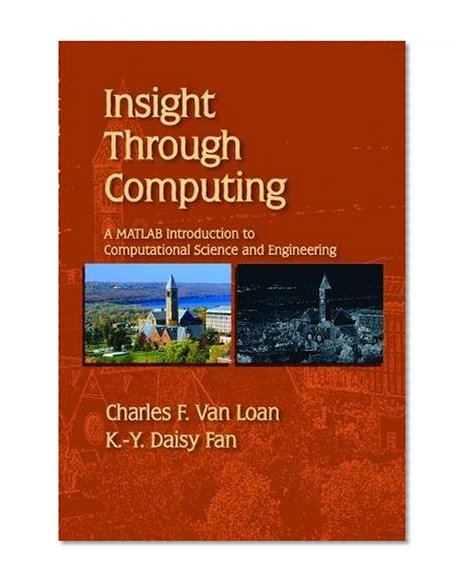


Insight Through Computing: A MATLAB Introduction to Computational Science and Engineering
Each section formulates a problem and then introduces those new MATLAB language features that are necessary to solve it. This approach puts problem-solving and algorithmic thinking first and syntactical details second. Each solution is followed by a talking point that concerns some related, larger issue associated with CSE. Collectively, the worked examples, talking points, and 300+ homework problems build intuition for the process of discretization and an appreciation for dimension, inexactitude, visualization, randomness, and complexity. This sets the stage for further coursework in CSE areas.
The interplay between programming and mathematics throughout the text reinforces the student s ability to reason numerically and geometrically.
Audience: Undergraduate students whose mathematical maturity is at the level of Calculus I will find this book extremely useful, especially as preparation for further courses in computing and mathematics. It can also be used as a MATLAB reference at any level.
Contents: Preface; MATLAB Glossary; Programming Topics; Software; Chapter 1: From Formula to Program; Chapter 2: Limits and Error; Chapter 3: Approximation with Fractions; Chapter 4: The Discrete versus the Continuous; Chapter 5: Abstraction; Chapter 6: Randomness; Chapter 7: The Second Dimension; Chapter 8: Reordering; Chapter 9: Search; Chapter 10: Points, Polygons, and Circles; Chapter 11: Text File Processing; Chapter 12: The Matrix: Part II; Chapter 13: Acoustic File Processing; Chapter 14: Divide and Conquer; Chapter 15: Optimization; Appendix A: Refined Graphics; Appendix B: Mathematical Facts; Appendix C: MATLAB, Java, and C; Appendix D: Exit Interview; Index


