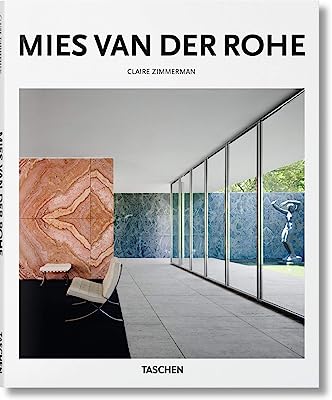


Mies van der Rohe (Basic Art Series 2.0)
Book Details
Author(s)
Claire Zimmerman
Publisher
TASCHEN
ISBN / ASIN
3836560429
ISBN-13
9783836560429
Availability
Usually ships in 24 hours
Sales Rank
#27,786
Marketplace
United States 🇺🇸
Ratings & Reviews
No reviews yet — be the first!
No reviews yet.
Description
Less is more: Finding perfection in purity
Famed for his motto “less is more,” Ludwig Mies van der Rohe (1886–1969) was one of the founding fathers of modern architecture and a hotly-debated tastemaker of twentieth century aesthetics and urban experience.
Mies van der Rohe's philosophy was one of underlying truth in pure forms and proportions. With the help of contemporary technological and material developments, he sought a stripped-down purity to architecture, showcased by the likes of the Seagram Building and Farnsworth House. Some spoke out against this stark approach as the precursor to bland, generic cityscapes. Others cite Mies van der Rohe as the ultimate master of an abdingly elegant essence.
This book presents more than 20 of Mies van der Rohe's projects from the period 1906–1967 to introduce his groundbreaking practice and influence in both America and Europe.
Mies van der Rohe's philosophy was one of underlying truth in pure forms and proportions. With the help of contemporary technological and material developments, he sought a stripped-down purity to architecture, showcased by the likes of the Seagram Building and Farnsworth House. Some spoke out against this stark approach as the precursor to bland, generic cityscapes. Others cite Mies van der Rohe as the ultimate master of an abdingly elegant essence.
This book presents more than 20 of Mies van der Rohe's projects from the period 1906–1967 to introduce his groundbreaking practice and influence in both America and Europe.
About the Series:
Each book in TASCHEN’s Basic Architecture Series features:
Each book in TASCHEN’s Basic Architecture Series features:
- an introduction to the life and work of the architect
- the major works in chronological order
- information about the clients, architectural preconditions as well as construction problems and resolutions
- a list of all the selected works and a map indicating the locations of the best and most famous buildings
- approximately 120 illustrations (photographs, sketches, drafts and plans)
Similar Products


