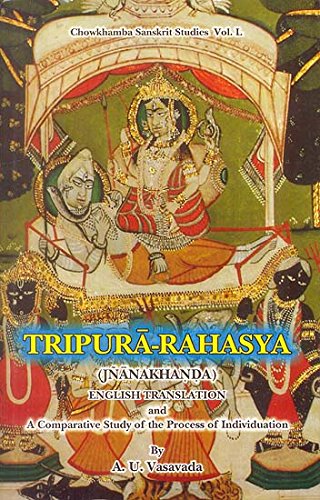


Tripura-Rahasya (Jnankhanda)
Book Details
Author(s)
A. U. Vasavada
Publisher
Chowkhamba Sanskrit Series Office
ISBN / ASIN
8170804167
ISBN-13
9788170804161
Sales Rank
#1,401,582
Marketplace
United States 🇺🇸
Ratings & Reviews
No reviews yet — be the first!
No reviews yet.
Description
Language: (Jnanakhanda English Translation and A Comparative Study of the Process of Individuation)
Pages: 238
Foreword
There are several reasons for which I am happy to write a preface to this enlightening work of my friend Vasavada.
1. The book, apart from having many other merits, is the crowning of the author's toil, work and studies in Zurich-Switzerland, which I had the pleasure of being an eyewitness of. While Dr. Vasavada has his unwavering faith, I admired him for, I had myself to go through more than one phase of doubt and discouragement, as the task of bringing the two worlds into line seemed enormous, if not presumptuous. All the more happy we were when it reached its what we thought satisfactory and convincing end where gratefulness of the gods united us.
2. The start to the almost superhuman task seemed to be made relatively easy by the existence of two of the fundamental Jungian concepts, i. e. extraversion and introversion. It is hardly any question that extraversion is the predominant attitude of the Westerner, whereas the East owes the depths of its philosophy and practice (Yoga) to an almost exclusively introverted approach. One could therefore, by the law of identity of the soul, expect that with Jung having been a born introvert his approach would of necessity show a lot of congruencies with the Eastern way to individuation (sit venia verbo).
3. The phenomenology of Analytical Psychology has in fact borne out that there are most striking similarities, so much so that the meaning of many of the products of analysis could only be understood after Jung had discovered the parallel phenomena in the Indian realm cf. technical terms like ('Self' or 'Mendala'). But he always maintained that his standpoint was strictly empirical, phenomenological and psychological, and that for these reasons he wou
Pages: 238
Foreword
There are several reasons for which I am happy to write a preface to this enlightening work of my friend Vasavada.
1. The book, apart from having many other merits, is the crowning of the author's toil, work and studies in Zurich-Switzerland, which I had the pleasure of being an eyewitness of. While Dr. Vasavada has his unwavering faith, I admired him for, I had myself to go through more than one phase of doubt and discouragement, as the task of bringing the two worlds into line seemed enormous, if not presumptuous. All the more happy we were when it reached its what we thought satisfactory and convincing end where gratefulness of the gods united us.
2. The start to the almost superhuman task seemed to be made relatively easy by the existence of two of the fundamental Jungian concepts, i. e. extraversion and introversion. It is hardly any question that extraversion is the predominant attitude of the Westerner, whereas the East owes the depths of its philosophy and practice (Yoga) to an almost exclusively introverted approach. One could therefore, by the law of identity of the soul, expect that with Jung having been a born introvert his approach would of necessity show a lot of congruencies with the Eastern way to individuation (sit venia verbo).
3. The phenomenology of Analytical Psychology has in fact borne out that there are most striking similarities, so much so that the meaning of many of the products of analysis could only be understood after Jung had discovered the parallel phenomena in the Indian realm cf. technical terms like ('Self' or 'Mendala'). But he always maintained that his standpoint was strictly empirical, phenomenological and psychological, and that for these reasons he wou
