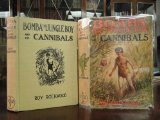
Bomba the Jungle Boy: The Moving Mountain
Book Details
Author(s)
Roy Rockwood
Publisher
Grosset & Dunlap
ISBN / ASIN
B000TXUSDW
ISBN-13
978B000TXUSD2
Sales Rank
#6,253,970
Marketplace
United States 🇺🇸
Ratings & Reviews
No reviews yet — be the first!
No reviews yet.
Description
From Wikipedia: Bomba the Jungle Boy is a series of American boy's adventure books produced by the Stratemeyer Syndicate under the pseudonym Roy Rockwood and published by Cupples & Leon in the first half of the 20th century in imitation of the successful Tarzan series.
There are 20 books in the series. The first ten are set in South America, where Bomba, who grew up in the jungle, tries to discover his origin. The second set of ten books shift the scene to Africa, where a slightly older Bomba has jungle adventures.
A common theme of the Bomba books is that Bomba, because he is white, has a soul that is awake, while his friends, the dark-skinned natives, have souls that are sleeping. Richard A. Lupoff, in his book "Master of Adventure," a study of the works of Tarzan creator Edgar Rice Burroughs, describes the Bomba tales as more blatantly racist than the oft-criticized Tarzan books.
In 1949, Monogram Pictures brought the character to the motion-picture screen, in the person of Johnny Sheffield. Sheffield was already established as an outdoor star; he had portrayed the character Boy in the Tarzan movies with Johnny Weissmuller. When the Bomba films, all set in Africa, proved popular with young audiences, the first 10 Bomba books were reprinted in the 1950s by Grosset & Dunlap, a publisher of many popular series books such as the Hardy Boys and Nancy Drew. These same books were reprinted again by Clover Books, a short-lived publisher that also reprinted the Grosset & Dunlap series Tom Quest.
In 1962, WGN-TV repackaged the Bomba films as a prime time series called Zim Bomba that became a local ratings sensation. WGN executive Fred Silverman stated that "Zim" meant "Son of" in Swahili.[1]