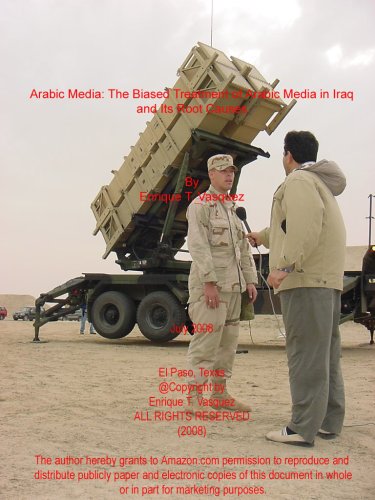


Arabic Media: The Biased Treatment of Arabic Media in Iraq and Its Root Causes
Book Details
Author(s)Enrique T. Vasquez
PublisherMaria's Enterprises
ISBN / ASINB001GS74PO
ISBN-13978B001GS74P6
Sales Rank2,047,345
MarketplaceUnited States 🇺🇸
Description
ABSTRACT
The Biased Treatment of Arabic Media and Its Root Causes
by
Enrique T. Vasquez
Western media versus Arabic media coverage of the war in Iraq is an ongoing struggle steered by both political agenda, and military influence. The United States for the first time since the American Civil War allowed the unrestricted access of media on the battlefield. During other wars the media did not enjoy an unrestricted access to military operation. However, the access of Arabic media in Iraq during Operation Iraqi Freedom (OIF) has proved limited and difficult at times. The U.S. government’s political agenda on media along with U.S. military’s Information Operations (IO) has played a significant part in the restrictions currently in place with regards to Arabic media.
Treatment of Arabic media is often unfair when addressing OIF. To prove this theme this thesis will examine the different facets of media that may have a direct or indirect affect on how the Arabic media. However, the causes and contributing factors will be the secondary research. The primary research is to be compiled from various sources to try to ensure a non-biased approach.
The primary means of research will come from a survey with military public affairs personnel and members of formerly embedded western media. Secondary research will come from published sources pertaining to Arabic and western media along with documents relating to embedded media. Surveying the general public to see how they perceive what western journalist and military public affairs personnel have to say can produce a compare and contrast picture of compiled data.
Primary research will ask the questions of whether or not people agree Arabic media is treated unfairly. This first question will be asked of the general public. The questions aimed at the general public will be more subjective with regards to how they feel about whether Arabic media is fairly allowed to cover the war Iraq versus the fairness of western media allowed to cover the war too. Other questions will be aimed at media personnel both military and civilian to see what they witnessed with regards to Arabic and western media embeds. The questions for the media are more objective as to whether they witnessed Arabic media in Iraq and what the frequency may have been.
With regards to the secondary I will look at media sources along with published documents and government reports on the how the media is being used in Iraq. To help support my thesis I plan to look at other factors, such as the lack of understanding of Arabic culture by U.S. government, western media outlets and the U.S. Army. In addition, the failures of the U.S. Army’s public affairs with other Department of Defense with regards to Abu- Ghraib, and other war cover-ups have brought discredit to the U.S. government and have affected how Arabic countries view the United States in Iraq.
Furthermore, the lack of positive control measures how U.S. military personnel blog and use cyber space have indirectly contributed the mistrust of many Arabic media outlets. Since, many of our Arabic adversaries use unofficial U.S. military blogs and websites to gather intelligence or fuel the insurgent media.
The insurgent media efforts are often confused with Arabic media therefore labeling both as a threat. There is some evidence that U.S. military have targeted Arabic media. However, since Arabic is often thought as being threatening they may be unjustly targets.
Other evidence suggests that there are Arabic media outlets that are not aligned with U.S. of Iraqi government policy. These groups of no-conforming Arabic media are known to cause friction and undermine U.S. efforts in the region. Neighboring Middle Eastern countries often use the media to push their views also.
The Biased Treatment of Arabic Media and Its Root Causes
by
Enrique T. Vasquez
Western media versus Arabic media coverage of the war in Iraq is an ongoing struggle steered by both political agenda, and military influence. The United States for the first time since the American Civil War allowed the unrestricted access of media on the battlefield. During other wars the media did not enjoy an unrestricted access to military operation. However, the access of Arabic media in Iraq during Operation Iraqi Freedom (OIF) has proved limited and difficult at times. The U.S. government’s political agenda on media along with U.S. military’s Information Operations (IO) has played a significant part in the restrictions currently in place with regards to Arabic media.
Treatment of Arabic media is often unfair when addressing OIF. To prove this theme this thesis will examine the different facets of media that may have a direct or indirect affect on how the Arabic media. However, the causes and contributing factors will be the secondary research. The primary research is to be compiled from various sources to try to ensure a non-biased approach.
The primary means of research will come from a survey with military public affairs personnel and members of formerly embedded western media. Secondary research will come from published sources pertaining to Arabic and western media along with documents relating to embedded media. Surveying the general public to see how they perceive what western journalist and military public affairs personnel have to say can produce a compare and contrast picture of compiled data.
Primary research will ask the questions of whether or not people agree Arabic media is treated unfairly. This first question will be asked of the general public. The questions aimed at the general public will be more subjective with regards to how they feel about whether Arabic media is fairly allowed to cover the war Iraq versus the fairness of western media allowed to cover the war too. Other questions will be aimed at media personnel both military and civilian to see what they witnessed with regards to Arabic and western media embeds. The questions for the media are more objective as to whether they witnessed Arabic media in Iraq and what the frequency may have been.
With regards to the secondary I will look at media sources along with published documents and government reports on the how the media is being used in Iraq. To help support my thesis I plan to look at other factors, such as the lack of understanding of Arabic culture by U.S. government, western media outlets and the U.S. Army. In addition, the failures of the U.S. Army’s public affairs with other Department of Defense with regards to Abu- Ghraib, and other war cover-ups have brought discredit to the U.S. government and have affected how Arabic countries view the United States in Iraq.
Furthermore, the lack of positive control measures how U.S. military personnel blog and use cyber space have indirectly contributed the mistrust of many Arabic media outlets. Since, many of our Arabic adversaries use unofficial U.S. military blogs and websites to gather intelligence or fuel the insurgent media.
The insurgent media efforts are often confused with Arabic media therefore labeling both as a threat. There is some evidence that U.S. military have targeted Arabic media. However, since Arabic is often thought as being threatening they may be unjustly targets.
Other evidence suggests that there are Arabic media outlets that are not aligned with U.S. of Iraqi government policy. These groups of no-conforming Arabic media are known to cause friction and undermine U.S. efforts in the region. Neighboring Middle Eastern countries often use the media to push their views also.
More Books by Enrique T. Vasquez

