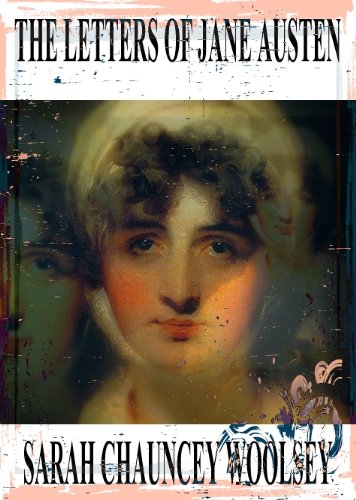


THE LETTERS OF JANE AUSTEN
Book Details
ISBN / ASINB00BERUNZ0
ISBN-13978B00BERUNZ2
Sales Rank534,913
MarketplaceUnited States 🇺🇸
Description
"We have been both to the exhibition and Sir J. Reynolds'; and I am disappointed, for there was nothing like Mrs. D. at either. I can only imagine that Mr. D. prizes any picture of her too much to like it should be exposed to the public eye. I can imagine he would have that sort of feeling,—that mixture of love, pride, and delicacy."
The letters included in this series comprise about three quarters of the collection in two volumes published in 1884 by her great-nephew Lord Brabourne. The lightness, almost friskiness, of their tone cannot fail to strike the reader. Modern letters written by women are filled more or less with hints and queries; questionings as to the why and the wherefore occur; allusions to the various "fads" of the day, literary or artistic,—Ibsen, Tolstoi, Browning, Esoteric Buddhism, Wagner's Music, the Mind Cure, Social Science, Causes and Reforms. But Cowper and Crabbe were the poetical sensations in Miss Austen's time, Scott and Byron its phenomenal novelties; it took months to get most books printed, and years to persuade anybody to read them. Furthermore the letters, in all probability, are carefully chosen to reveal only the more superficial side of their writer. There are wide gaps of omission, covering important events such as Mr. Austen's death, the long illness through which Jane nursed her brother Henry, and the anxieties and worries which his failure in business caused to the whole family. What is vouchsafed us is a glimpse of the girlish and untroubled moments of Miss Austen's life; and the glimpse is a sweet and friendly one. We are glad to have it, in spite of our suspicion that another and even more interesting part of her personality is withheld from us.
A good daughter, a delightful sister, the most perfect of aunts, what better record could there be of a single woman? Her literary work never stood in the way of her home duties, any more than her "quiet, limpid, unimpassioned style" stood between her thought and her readers.
Her fame may justly be said to be almost entirely posthumous. She was read and praised to a moderate degree during her lifetime, but all her novels together brought her no more than seven hundred pounds; and her reputation, as it were, was in its close-sheathed bud when, at the early age of forty-one, she died. It would have excited in her an amused incredulity, no doubt, had any one predicted that two generations after her death the real recognition of her powers was to come. Time, which like desert sands has effaced the footprints of so many promising authors, has, with her, served as the desert wind, to blow aside those dusts of the commonplace which for a while concealed her true proportions. She is loved more than she ever hoped to be, and far more widely known. Mrs. Ritchie tells somewhere an anecdote of a party of seven assembled at a dinner-table, where the question arose of the locality of one of Miss Austen's places,—Maple Grove, the residence of Mr. Suckling, if we are not mistaken,—and six of the persons present at once recognized the allusion, and had a formed opinion on the subject. The seventh was a Frenchman who did not read English!
Scott, Macaulay, Sir James Mackintosh, Miss Martineau, Mrs. Ritchie, Miss Mitford, and a host of others have vied in their generous tributes of admiration. But most striking of all, to our thinking, is that paid to Miss Austen by Lord Tennyson when, in some visit to Lyme not many years since, those with him pointed out this and the other feature of the place only to be interrupted with—"Never mind all that. Show me the exact spot where Louisa Musgrove fell!" Could non-historical verisimilitude go farther or mean more?
S. C. W.
NEWPORT, June, 1892.
The letters included in this series comprise about three quarters of the collection in two volumes published in 1884 by her great-nephew Lord Brabourne. The lightness, almost friskiness, of their tone cannot fail to strike the reader. Modern letters written by women are filled more or less with hints and queries; questionings as to the why and the wherefore occur; allusions to the various "fads" of the day, literary or artistic,—Ibsen, Tolstoi, Browning, Esoteric Buddhism, Wagner's Music, the Mind Cure, Social Science, Causes and Reforms. But Cowper and Crabbe were the poetical sensations in Miss Austen's time, Scott and Byron its phenomenal novelties; it took months to get most books printed, and years to persuade anybody to read them. Furthermore the letters, in all probability, are carefully chosen to reveal only the more superficial side of their writer. There are wide gaps of omission, covering important events such as Mr. Austen's death, the long illness through which Jane nursed her brother Henry, and the anxieties and worries which his failure in business caused to the whole family. What is vouchsafed us is a glimpse of the girlish and untroubled moments of Miss Austen's life; and the glimpse is a sweet and friendly one. We are glad to have it, in spite of our suspicion that another and even more interesting part of her personality is withheld from us.
A good daughter, a delightful sister, the most perfect of aunts, what better record could there be of a single woman? Her literary work never stood in the way of her home duties, any more than her "quiet, limpid, unimpassioned style" stood between her thought and her readers.
Her fame may justly be said to be almost entirely posthumous. She was read and praised to a moderate degree during her lifetime, but all her novels together brought her no more than seven hundred pounds; and her reputation, as it were, was in its close-sheathed bud when, at the early age of forty-one, she died. It would have excited in her an amused incredulity, no doubt, had any one predicted that two generations after her death the real recognition of her powers was to come. Time, which like desert sands has effaced the footprints of so many promising authors, has, with her, served as the desert wind, to blow aside those dusts of the commonplace which for a while concealed her true proportions. She is loved more than she ever hoped to be, and far more widely known. Mrs. Ritchie tells somewhere an anecdote of a party of seven assembled at a dinner-table, where the question arose of the locality of one of Miss Austen's places,—Maple Grove, the residence of Mr. Suckling, if we are not mistaken,—and six of the persons present at once recognized the allusion, and had a formed opinion on the subject. The seventh was a Frenchman who did not read English!
Scott, Macaulay, Sir James Mackintosh, Miss Martineau, Mrs. Ritchie, Miss Mitford, and a host of others have vied in their generous tributes of admiration. But most striking of all, to our thinking, is that paid to Miss Austen by Lord Tennyson when, in some visit to Lyme not many years since, those with him pointed out this and the other feature of the place only to be interrupted with—"Never mind all that. Show me the exact spot where Louisa Musgrove fell!" Could non-historical verisimilitude go farther or mean more?
S. C. W.
NEWPORT, June, 1892.
