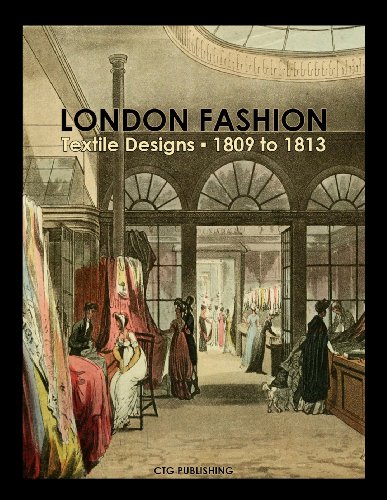


London Textile Designs of 1800
Book Details
Author(s)
Melanie Paquette Widmann
Publisher
CTG Publishing
ISBN / ASIN
B00C0CTTGC
ISBN-13
978B00C0CTTG2
Sales Rank
#1,576,804
Marketplace
United States 🇺🇸
Ratings & Reviews
No reviews yet — be the first!
No reviews yet.
Description
Find inspiration in the textile [fabric] and fashion designs of the Romantic period, an era that has inspired many including Art Nouveau and Art Deco artists. I hope you enjoy the collection of antique fashion prints and fabric swatch images from The Repository of arts, literature, commerce, manufactures, fashions and politics (1809 - 1813) by Rudolph Ackermann.
The Repository of arts, literature, commerce, manufactures, fashions and politics is a testament of the entrepreneurial spirit of Rudolph Ackermann. According to the University of Cambridge*, Rudolph Ackermann was born in Stollberg, Saxony in 1764. He first was a saddler and then worked as a carriage maker. In 1787, at the age of twenty-two, he moved to London. He married in 1792 and was naturalized in 1809.
In 1795, he set up a lithographic press at 96 Strand, moved to 101 Strand in 1797 and then returned to a new building at 96 Strand in 1827. By 1800, he was the “leading publisher of colour-plate books, decorative prints, fashionable periodicals and political caricatures in London.†His business was called the Repository of Arts and acted as a shop and social gathering place. It sold prints, artist’s materials, drawing lessons and included a gallery and private library. Ackermann died in 1834.
The Repository of arts, literature, commerce, manufactures, fashions and politics is a testament of the entrepreneurial spirit of Rudolph Ackermann. According to the University of Cambridge*, Rudolph Ackermann was born in Stollberg, Saxony in 1764. He first was a saddler and then worked as a carriage maker. In 1787, at the age of twenty-two, he moved to London. He married in 1792 and was naturalized in 1809.
In 1795, he set up a lithographic press at 96 Strand, moved to 101 Strand in 1797 and then returned to a new building at 96 Strand in 1827. By 1800, he was the “leading publisher of colour-plate books, decorative prints, fashionable periodicals and political caricatures in London.†His business was called the Repository of Arts and acted as a shop and social gathering place. It sold prints, artist’s materials, drawing lessons and included a gallery and private library. Ackermann died in 1834.