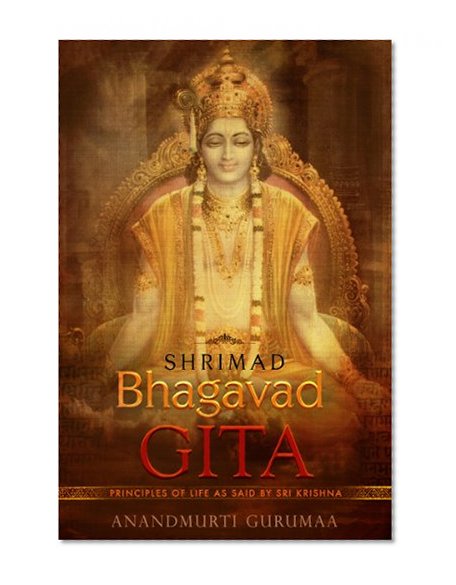
Shrimad Bhagavad Gita - VOL 1 (Chapters 1 - 6)
Book Details
Author(s)Anandmurti Gurumaa
PublisherGurumaa Vani
ISBN / ASINB00DS7MXD4
ISBN-13978B00DS7MXD5
Sales Rank1,297,094
MarketplaceUnited States 🇺🇸
Description
“OM SHRI PARMÄ€TMANÉ NAMAḤâ€
The syllable ‘OM’ (pronounced as ‘AUM’) refers to Brahman which is satya (truth), chaitanya (ever-conscious), Änanda (bliss) & vyÄpaka (all pervasive). The syllable has three limbs viz. ‘A’, ‘U’ &‘M’ symbolising the three bodies, the three states of the JÄ«va, & the three reflected egos resulting from identification with the three states.
The JÄ«va has three bodies viz. gross, subtle & causal, & with these three bodies respectively, the JÄ«va moves to & fro between the three states of waking, dreaming & sleeping. & corresponding to these three states, the JÄ«va is referred to as Vishwa, Téjas & PrÄgya respectively.
That which is called as Vishwa, Téjas & PrÄgya in vyaá¹£á¹i is termed as VaishwÄnar, SutrÄtma & AntaryÄmi, respectively, in samaá¹£á¹i.
The terms vyaá¹£á¹i & samaá¹£á¹i can be understood through this example: vyaá¹£á¹i refers to the individual drops of water in an ocean, whereas samaá¹£á¹i is the ocean which is the collective amalgamation of all those individual drops.
So, sum total of billions of individual drops is the ocean. But if you compare one drop with the entire ocean, they seem so different. Different in size, shape, & moreover, in the sheer power of an ocean compared to tiny drop. However, be it in a drop or in ocean, the water is same.
Likewise, using the same corollary, what is the status of the Jīva? Nothing. It is born ignorant & powerless, although manifold.
So JÄ«va is plural, manifold. And every JÄ«va is traversing through three states of waking, dreaming & sleeping. In vyaá¹£á¹i it is known as JÄ«va, whereas in samaá¹£á¹i it is known as Ishwara. Ishwara is singular, omniscient & omnipotent, whereas JÄ«va is manifold, ignorant & feeble. Such a vast difference between the two! But this seeming contrast notwithstanding, the chétanÄ (consciousness) in both of them is one and the same.
The only thing is that the chétanÄ within a JÄ«va is known as Ä€tma-chétanÄ, whereas the chétanÄ present in Ishwara is known as Brahman.
The three limbs of ‘OM’ also reflect the three gunas underlying the entire manifest world viz. sattva, rajas & tamas. All these are comprehensively represented in one syllable ‘OM’.
Essentially ‘OM’ symbolises Brahman, JÄ«va, Ishwara, Prakriti, this entire manifest world & all the different states of existence happening in this world. ‘OM’, as written in the DevanÄgri script, also includes the amÄtrÄ which is drawn at the side & is shaped like a half-moon. & this alludes to the one who is transcendental, omniscient, eternal, & beyond.
With this symbol begins the opening veneration ‘OM SHRI PARMĀTMANÉ NAMAḤ’ (wherein the word ‘Shri’ indicates the one who is sentient, conscious), a reverence to the divine which means, ‘We salute the supreme Lord whose essential nature is symbolised by the syllable ‘OM’.’
And it is with this salutation that we embark on the journey which will take us through the hallowed text of Srīmad Bhagavad Gīta, song sung by God. Here, God refers to Lord Sri Krishna. And who is Krishna? Ishwara, divine incarnation, endowed with supreme opulence of power, force of Maya. And here, we are saluting the incarnation of this very Ishwara viz. Lord Sri Krishna & his divine song which is the Bhagavad Gīta.
Herein, do note that Bhagavad Gīta is a song & not a didactic instruction. Bhagavad Gīta is commonly regarded as a sermon given by Sri Krishna to Arjuna – well, this is wrong! Sri Krishna did not deliver any formal lecture, he was not sermonising; he was just singing a song. Although it is another matter that seeing the distressed state of Arjuna, who was bound by his attachments, Sri Krishna simply guided him out of sheer compassion.
Arjuna had said that he wanted to become Sri Krishna’s disciple. But did Sri Krishna ever say that he would become Arjuna’s Guru, his master? No! Srīmad Bhagavad Gīta is a divine song sung by the Lord & it should be listened to in that very joyous spirit, as that of Sri Krishna whilst he blissfully sang this sacred song.

The syllable ‘OM’ (pronounced as ‘AUM’) refers to Brahman which is satya (truth), chaitanya (ever-conscious), Änanda (bliss) & vyÄpaka (all pervasive). The syllable has three limbs viz. ‘A’, ‘U’ &‘M’ symbolising the three bodies, the three states of the JÄ«va, & the three reflected egos resulting from identification with the three states.
The JÄ«va has three bodies viz. gross, subtle & causal, & with these three bodies respectively, the JÄ«va moves to & fro between the three states of waking, dreaming & sleeping. & corresponding to these three states, the JÄ«va is referred to as Vishwa, Téjas & PrÄgya respectively.
That which is called as Vishwa, Téjas & PrÄgya in vyaá¹£á¹i is termed as VaishwÄnar, SutrÄtma & AntaryÄmi, respectively, in samaá¹£á¹i.
The terms vyaá¹£á¹i & samaá¹£á¹i can be understood through this example: vyaá¹£á¹i refers to the individual drops of water in an ocean, whereas samaá¹£á¹i is the ocean which is the collective amalgamation of all those individual drops.
So, sum total of billions of individual drops is the ocean. But if you compare one drop with the entire ocean, they seem so different. Different in size, shape, & moreover, in the sheer power of an ocean compared to tiny drop. However, be it in a drop or in ocean, the water is same.
Likewise, using the same corollary, what is the status of the Jīva? Nothing. It is born ignorant & powerless, although manifold.
So JÄ«va is plural, manifold. And every JÄ«va is traversing through three states of waking, dreaming & sleeping. In vyaá¹£á¹i it is known as JÄ«va, whereas in samaá¹£á¹i it is known as Ishwara. Ishwara is singular, omniscient & omnipotent, whereas JÄ«va is manifold, ignorant & feeble. Such a vast difference between the two! But this seeming contrast notwithstanding, the chétanÄ (consciousness) in both of them is one and the same.
The only thing is that the chétanÄ within a JÄ«va is known as Ä€tma-chétanÄ, whereas the chétanÄ present in Ishwara is known as Brahman.
The three limbs of ‘OM’ also reflect the three gunas underlying the entire manifest world viz. sattva, rajas & tamas. All these are comprehensively represented in one syllable ‘OM’.
Essentially ‘OM’ symbolises Brahman, JÄ«va, Ishwara, Prakriti, this entire manifest world & all the different states of existence happening in this world. ‘OM’, as written in the DevanÄgri script, also includes the amÄtrÄ which is drawn at the side & is shaped like a half-moon. & this alludes to the one who is transcendental, omniscient, eternal, & beyond.
With this symbol begins the opening veneration ‘OM SHRI PARMĀTMANÉ NAMAḤ’ (wherein the word ‘Shri’ indicates the one who is sentient, conscious), a reverence to the divine which means, ‘We salute the supreme Lord whose essential nature is symbolised by the syllable ‘OM’.’
And it is with this salutation that we embark on the journey which will take us through the hallowed text of Srīmad Bhagavad Gīta, song sung by God. Here, God refers to Lord Sri Krishna. And who is Krishna? Ishwara, divine incarnation, endowed with supreme opulence of power, force of Maya. And here, we are saluting the incarnation of this very Ishwara viz. Lord Sri Krishna & his divine song which is the Bhagavad Gīta.
Herein, do note that Bhagavad Gīta is a song & not a didactic instruction. Bhagavad Gīta is commonly regarded as a sermon given by Sri Krishna to Arjuna – well, this is wrong! Sri Krishna did not deliver any formal lecture, he was not sermonising; he was just singing a song. Although it is another matter that seeing the distressed state of Arjuna, who was bound by his attachments, Sri Krishna simply guided him out of sheer compassion.
Arjuna had said that he wanted to become Sri Krishna’s disciple. But did Sri Krishna ever say that he would become Arjuna’s Guru, his master? No! Srīmad Bhagavad Gīta is a divine song sung by the Lord & it should be listened to in that very joyous spirit, as that of Sri Krishna whilst he blissfully sang this sacred song.