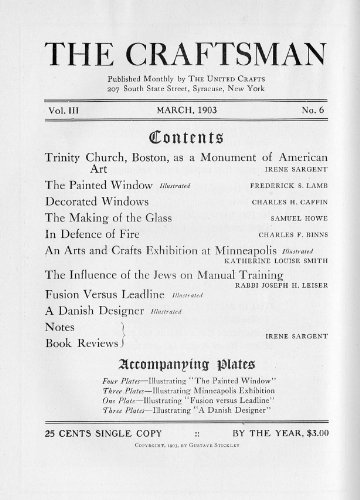


The Craftsman Magazine-Volume 3, Number 6-March 1903
Book Details
Author(s)
Gustav Stickley
Publisher
GraceWorks Multimedia
ISBN / ASIN
B00DVL8PUC
ISBN-13
978B00DVL8PU8
Sales Rank
#99,999,999
Marketplace
United States 🇺🇸
Ratings & Reviews
No reviews yet — be the first!
No reviews yet.
Description
You are about to download the Volume 3, Number 6 issue of The Craftsman Magazine from March 1903.
The Craftsman was a magazine founded by Gustav Stickley in 1901 which carried house designs that created the American Craftsman architectural style. Stickley's own home in Syracuse, New York, became the first Craftsman home. Views of its interior and plans were published in 1903 in The Craftsman.
Gustav Stickley (March 9, 1858 – April 21, 1942) was a furniture manufacturer, design leader, publisher and the chief proselytizer for the American Craftsman style, an extension of the British Arts and Crafts Movement.
The first issue of Gustav Stickley's The Craftsman magazine was produced in 1901. From its inception it was meant to be seen as a vehicle to promote the philosophy of the English Arts & Crafts movement across North America. This can be seen quite clearly with its first issue, which was dedicated entirely to the recently deceased William Morris, while the second issue was dedicated to the also recently deceased John Ruskin.
However, as the magazine matured it gradually took on a more native, home-grown element, promoting the by now burgeoning American Arts & Crafts movement. The magazine took the basic ideas behind the English Arts & Crafts philosophy and moulded them to suit an American environment.
The magazine promoted an all-encompassing simple life philosophy, which included in its remit, architecture, interior design and decoration, gardening and lifestyle. This largely home-grown idyll had elements of colonial reminiscences, so while the English movement tried to foster links with the English and European medieval period, the American tried to forge links with its own historical infancy. Of course, it must be admitted that most of the Arts & Crafts linkage with past eras was based largely on a fictitious nostalgia, but in the end that really is not that important. What is important is that the American Arts & Crafts movement which was a fairly broad grouping of elements from a number of disciplines including architecture, furniture, metal, ceramic and textile design, was making the first steps towards a recognition of American cultural uniqueness.
The gradual independence of the American Arts & Crafts movement from the European and particularly English movements, helped to foster the idea of America as a separate entity in its own right.
The Craftsman magazine by highlighting and encouraging the home-grown elements of the Arts & Crafts philosophy, helped to embolden the differences rather than the similarities between the two continents. Although the international aspect of the Arts & Crafts movement was tangible and many of the different national groups around the world did share a similar philosophy, the great strength of the Arts & Crafts movement was that it was adaptable to any number of native customs and cultures. It did much to bolster a reconnection that those cultures had with their own native history and traditions, which were then transmitted into contemporary architecture, design and craft.
The Craftsman magazine ceased publication in 1916. The impending threat of American involvement in the First World War and the general disruption of markets and finances caused by that war put an end to the magazine. However, during its fifteen years of publication it had become the most read magazine of its type across North America and had helped to foster a dynamism within American mediums like architecture, interior decoration, furniture, metalwork and ceramics, which was to long outlive its short publication run.
The Craftsman was a magazine founded by Gustav Stickley in 1901 which carried house designs that created the American Craftsman architectural style. Stickley's own home in Syracuse, New York, became the first Craftsman home. Views of its interior and plans were published in 1903 in The Craftsman.
Gustav Stickley (March 9, 1858 – April 21, 1942) was a furniture manufacturer, design leader, publisher and the chief proselytizer for the American Craftsman style, an extension of the British Arts and Crafts Movement.
The first issue of Gustav Stickley's The Craftsman magazine was produced in 1901. From its inception it was meant to be seen as a vehicle to promote the philosophy of the English Arts & Crafts movement across North America. This can be seen quite clearly with its first issue, which was dedicated entirely to the recently deceased William Morris, while the second issue was dedicated to the also recently deceased John Ruskin.
However, as the magazine matured it gradually took on a more native, home-grown element, promoting the by now burgeoning American Arts & Crafts movement. The magazine took the basic ideas behind the English Arts & Crafts philosophy and moulded them to suit an American environment.
The magazine promoted an all-encompassing simple life philosophy, which included in its remit, architecture, interior design and decoration, gardening and lifestyle. This largely home-grown idyll had elements of colonial reminiscences, so while the English movement tried to foster links with the English and European medieval period, the American tried to forge links with its own historical infancy. Of course, it must be admitted that most of the Arts & Crafts linkage with past eras was based largely on a fictitious nostalgia, but in the end that really is not that important. What is important is that the American Arts & Crafts movement which was a fairly broad grouping of elements from a number of disciplines including architecture, furniture, metal, ceramic and textile design, was making the first steps towards a recognition of American cultural uniqueness.
The gradual independence of the American Arts & Crafts movement from the European and particularly English movements, helped to foster the idea of America as a separate entity in its own right.
The Craftsman magazine by highlighting and encouraging the home-grown elements of the Arts & Crafts philosophy, helped to embolden the differences rather than the similarities between the two continents. Although the international aspect of the Arts & Crafts movement was tangible and many of the different national groups around the world did share a similar philosophy, the great strength of the Arts & Crafts movement was that it was adaptable to any number of native customs and cultures. It did much to bolster a reconnection that those cultures had with their own native history and traditions, which were then transmitted into contemporary architecture, design and craft.
The Craftsman magazine ceased publication in 1916. The impending threat of American involvement in the First World War and the general disruption of markets and finances caused by that war put an end to the magazine. However, during its fifteen years of publication it had become the most read magazine of its type across North America and had helped to foster a dynamism within American mediums like architecture, interior decoration, furniture, metalwork and ceramics, which was to long outlive its short publication run.


