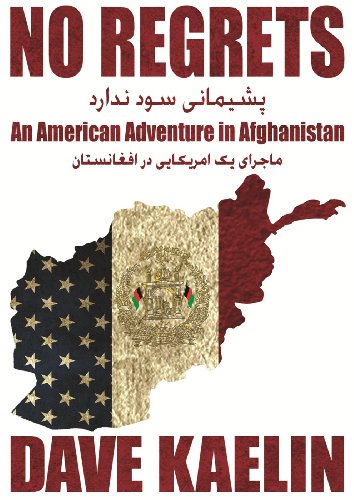


NO REGRETS: An American Adventure in Afghanistan
Book Details
Author(s)
David Kaelin
Publisher
Dave Kaelin
ISBN / ASIN
B00GR7C4OA
ISBN-13
978B00GR7C4O1
Sales Rank
#421,636
Marketplace
United States 🇺🇸
Description
No Regrets is a sometimes humorous and irreverent look at the war in Afghanistan from a different voice and perspective -- a defense contractor. A year and half after the Twin Towers fell in New York City, the author, Dave, found himself in Bagram, Afghanistan working for KBR—the notorious Halliburton defense contractor. Over the next decade, he traveled across Afghanistan as part of the U.S.-led military campaign “Operation Enduring Freedom.†During that time, he finagled his way accounting clerk to a senior advisor and mentor for Afghan colonels and generals in the western region of Afghanistan. Shona ba Shona (side-by-side) with the Afghan police and the Coalition military forces, Dave Kaelin and the men and women with whom he worked strove to build the Afghan National Security Forces (ANSF) into a professional military command capable of defending and protecting the nation and the people of Afghanistan. Along the way, Dave navigates through challenging cultural minefields, sells the U.S. Army on its own programs, and finds maniacal cures for the boredom of a war zone as the military decides how to proceed with the Afghanistan drawdown...and he curses...a lot.
The author tells the tale. He leaves it up to the reader to decide what is good, bad or indiscernible.
Below is a review of No Regrets by Sir Rodric Braithwaite, British Diplomat and Author:
***********
Dave Kaelin’s lively and colourful memoir is a pleasure to read and gives a fascinating picture of the war in Afghanistan from an unusual angle. Kaelin was not a soldier there, nor a diplomat, nor an aid worker, nor a journalist. He was a contractor to the US military, one of a very large group of civilians engaged in tasks which even the US military is no longer prepared to do for itself: security, logistics, construction, administration. They also do what is called in the jargon ‘mentoring’ - training Afghans in various more or less useful Western skills. Thanks not least to some major scandals, such the one that engulfed the security company Blackwater in Iraq, many foreigners in Afghanistan regarded the civilian contractors with suspicion. Civilian contractors who met a violent end at the hands of the Taliban were rarely accorded the honours that a soldier would have received: he or she was simply shoved in a box and shipped home.
Western soldiers taught Afghans how to handle their weapons and how to operate in
battle according to the latest Western military manuals. Most Afghans are skilled in
the use of weapons from an early age. Their favourite arm was the AK47, the
Kalashnikov, of which large numbers had been swilling around the country since the
Soviet invasion. The Americans decided - for good military or perhaps for commercial reasons that the new Afghan army would be better off with American M16 - more sophisticated but less reliable than the weapons the Afghans were already used to.
Civilian mentors taught a variety of non-military skills. Dave Kaelin’s task was to
persuade Afghan policemen and soldiers to adopt esoteric administrative procedures, such as how to keep track of equipment and ammunition, and how to make sure that fuel did not go astray. This activity was well-meaning, but its utility was unclear. Kaelin discovered that some of the people he was mentoring had already been trained by the Soviets in their own perfectly adequate accounting system. But the American authorities decided to get rid of the Soviet system as they had got rid of the Kalashnikovs. Other trainees were illiterate, having been rounded up by the local warlords to meet a quota. Many of the more able and powerful were not interested in implementing systems that could limit their traditional freedom to distribute resources to their friends and patrons, the give and take which lubricates the wheels of Afghan society, but which we Westerners call ‘corruption’.
(Continued in attached .jpeg.)
The author tells the tale. He leaves it up to the reader to decide what is good, bad or indiscernible.
Below is a review of No Regrets by Sir Rodric Braithwaite, British Diplomat and Author:
***********
Dave Kaelin’s lively and colourful memoir is a pleasure to read and gives a fascinating picture of the war in Afghanistan from an unusual angle. Kaelin was not a soldier there, nor a diplomat, nor an aid worker, nor a journalist. He was a contractor to the US military, one of a very large group of civilians engaged in tasks which even the US military is no longer prepared to do for itself: security, logistics, construction, administration. They also do what is called in the jargon ‘mentoring’ - training Afghans in various more or less useful Western skills. Thanks not least to some major scandals, such the one that engulfed the security company Blackwater in Iraq, many foreigners in Afghanistan regarded the civilian contractors with suspicion. Civilian contractors who met a violent end at the hands of the Taliban were rarely accorded the honours that a soldier would have received: he or she was simply shoved in a box and shipped home.
Western soldiers taught Afghans how to handle their weapons and how to operate in
battle according to the latest Western military manuals. Most Afghans are skilled in
the use of weapons from an early age. Their favourite arm was the AK47, the
Kalashnikov, of which large numbers had been swilling around the country since the
Soviet invasion. The Americans decided - for good military or perhaps for commercial reasons that the new Afghan army would be better off with American M16 - more sophisticated but less reliable than the weapons the Afghans were already used to.
Civilian mentors taught a variety of non-military skills. Dave Kaelin’s task was to
persuade Afghan policemen and soldiers to adopt esoteric administrative procedures, such as how to keep track of equipment and ammunition, and how to make sure that fuel did not go astray. This activity was well-meaning, but its utility was unclear. Kaelin discovered that some of the people he was mentoring had already been trained by the Soviets in their own perfectly adequate accounting system. But the American authorities decided to get rid of the Soviet system as they had got rid of the Kalashnikovs. Other trainees were illiterate, having been rounded up by the local warlords to meet a quota. Many of the more able and powerful were not interested in implementing systems that could limit their traditional freedom to distribute resources to their friends and patrons, the give and take which lubricates the wheels of Afghan society, but which we Westerners call ‘corruption’.
(Continued in attached .jpeg.)
