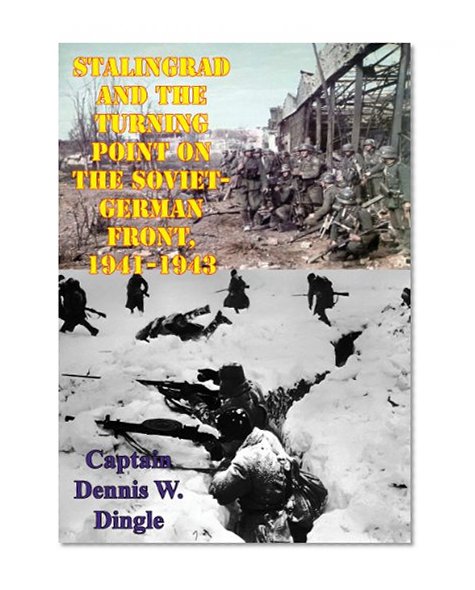


Stalingrad and the Turning Point on the Soviet-German Front, 1941-1943
Book Details
Author(s)
Captain Dennis W. Dingle
Publisher
Pickle Partners Publishing
ISBN / ASIN
B00JMHCXKM
ISBN-13
978B00JMHCXK2
Sales Rank
#1,435,236
Marketplace
United States 🇺🇸
Description
This study is an historical analysis of the Soviet-German conflict during World War II and focuses on the years 1941-1943. It examines the relative economic and military power of the two nations to determine if there was a shift in advantage, or turning point, during that period. To quantify those elements of power, it uses criteria taken from a current strategic analysis model. This model assesses elements of national power to aid in strategic problem solving and international policy formulation. Specific criteria are applied to four specific military events between 1941 and 1943. The resulting data is then graphed to compare relative military and economic power. The graphs serve as the basis for conclusions.
Among the conclusions which may be drawn from this study are: the Battle of Stalingrad was not the economic turning point of the war when considering the criteria of industrial labor and armaments production; Stalingrad was the military turning point, considering military forces and equipment on the Soviet-German front.
This study concludes that this method of assessing relative national power of nations can be applied in an historical context to evaluate past wars. It may assist historians to better understand the factors that led to various turning points throughout history.
Among the conclusions which may be drawn from this study are: the Battle of Stalingrad was not the economic turning point of the war when considering the criteria of industrial labor and armaments production; Stalingrad was the military turning point, considering military forces and equipment on the Soviet-German front.
This study concludes that this method of assessing relative national power of nations can be applied in an historical context to evaluate past wars. It may assist historians to better understand the factors that led to various turning points throughout history.
