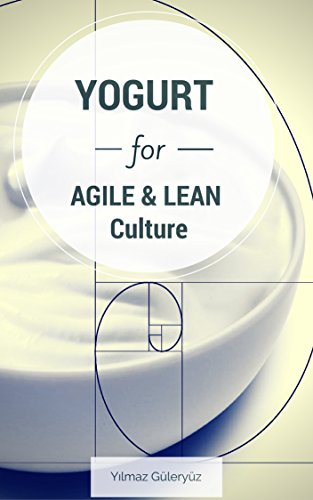
YOGURT for Agile & Lean Culture: Discovered thru Practice, Inspired by Nature
Book Details
Author(s)Yilmaz Guleryuz
Publisher@guleryuz
ISBN / ASINB00LF4U5U0
ISBN-13978B00LF4U5U3
Sales Rank1,542,936
MarketplaceUnited States 🇺🇸
Description
Most of my arguments are based on my own adaptation of Musashi style:
Agile & Lean practices must be understood as though the practitioner himself had discovered them from his own mind. Learn about all of them, but never become fond of any.
My purpose is to make you aware of the many facets of Agile & Lean practices. With that attitude you may analyse any situation, and decide on the best procedures to adapt and apply accordingly. What I hope to do is help you think about workplace culture with more practical and natural ways.
Why authorship?
Because knowledge is more valuable when you share it. Because learn-teach-share is good for the soul, and it leads to growth altogether, but mainly because... Sharing is Caring!
---
Disclaimer!
This book is not a Shakespearian play, Homeric poetry, nor a fiction book written by using English language masterfully...
I'm aware of the fact that I may have done some grammar mistakes here and there, and I have no excuse other than expressing that I'm continuously practising also to develop my writing skills.
Nevertheless, I kindly ask your understanding and direct your attention on the techniques and methodologies presented in this book instead of focusing on the grammar mistakes.
This book is intended to help you in bettering your workplace. Hence, content and applicability of the methods are the main focal point.
---
This book contains 4 (four) chapters with subsections related to Toolbox, Compass, Storyline, and Experiential. While each chapter can be regarded and read as self-contained notebook, still they are all interconnected.
Contents:
> Chapter.1 : A Primer on Agile Mindset
>> 1.1 Finding the Direction
>> 1.2 Overview and Terminology
>> 1.3 Caveats: Beware of the Downsides
> Chapter.2 : Set of Techniques for the Foundation
>> 2.1 Fibonacci Pairing: Learning through Collaboration
>> 2.2 Common Language as a Contextual Medium
>> 2.3 Slicing, Timeboxing, and matters of Sharpness
>> 2.4 Forming Teams as Organisms
>> 2.5 The importance of Naming
>> 2.6 Presence and Ownership
> Chapter.3 : COMPASS for Continuous Delivery
>> 3.1 The Foundational Aspects
>> 3.2 The Five C s in Action
> Chapter.4 Experiential Learnings : once upon a time
>> 4.1 A Practical Storyline in Action
>> 4.2 About Remote Teams
If this book inspires you, how delightful would that make the humble author myself.
Please read with patience, and remember to share your feedback.
Agile & Lean practices must be understood as though the practitioner himself had discovered them from his own mind. Learn about all of them, but never become fond of any.
My purpose is to make you aware of the many facets of Agile & Lean practices. With that attitude you may analyse any situation, and decide on the best procedures to adapt and apply accordingly. What I hope to do is help you think about workplace culture with more practical and natural ways.
Why authorship?
Because knowledge is more valuable when you share it. Because learn-teach-share is good for the soul, and it leads to growth altogether, but mainly because... Sharing is Caring!
---
Disclaimer!
This book is not a Shakespearian play, Homeric poetry, nor a fiction book written by using English language masterfully...
I'm aware of the fact that I may have done some grammar mistakes here and there, and I have no excuse other than expressing that I'm continuously practising also to develop my writing skills.
Nevertheless, I kindly ask your understanding and direct your attention on the techniques and methodologies presented in this book instead of focusing on the grammar mistakes.
This book is intended to help you in bettering your workplace. Hence, content and applicability of the methods are the main focal point.
---
This book contains 4 (four) chapters with subsections related to Toolbox, Compass, Storyline, and Experiential. While each chapter can be regarded and read as self-contained notebook, still they are all interconnected.
Contents:
> Chapter.1 : A Primer on Agile Mindset
>> 1.1 Finding the Direction
>> 1.2 Overview and Terminology
>> 1.3 Caveats: Beware of the Downsides
> Chapter.2 : Set of Techniques for the Foundation
>> 2.1 Fibonacci Pairing: Learning through Collaboration
>> 2.2 Common Language as a Contextual Medium
>> 2.3 Slicing, Timeboxing, and matters of Sharpness
>> 2.4 Forming Teams as Organisms
>> 2.5 The importance of Naming
>> 2.6 Presence and Ownership
> Chapter.3 : COMPASS for Continuous Delivery
>> 3.1 The Foundational Aspects
>> 3.2 The Five C s in Action
> Chapter.4 Experiential Learnings : once upon a time
>> 4.1 A Practical Storyline in Action
>> 4.2 About Remote Teams
If this book inspires you, how delightful would that make the humble author myself.
Please read with patience, and remember to share your feedback.

