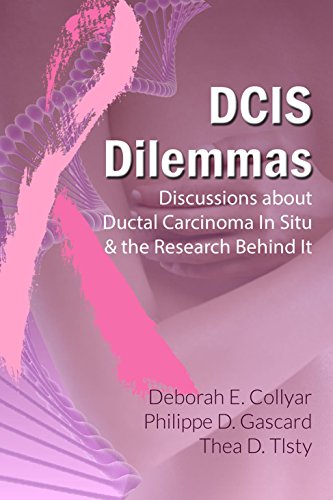


DCIS Dilemmas: Discussions about Ductal Carcinoma In Situ & the Research Behind It
Book Details
Author(s)Collyar, Deborah E.
ISBN / ASINB016NH4JOQ
ISBN-13978B016NH4JO1
AvailabilityAvailable for download now
Sales Rank6,303
CategoryKindle Edition
MarketplaceUnited States 🇺🇸
Description
Women often think that their risk of getting Ductal Carcinoma In Situ (DCIS) or Invasive Breast Cancer (IBC) is much higher than real numbers show. This fear is often fed by new stories about research, and sometimes by their own doctors. Many doctors and researchers say that DCIS is not Invasive Breast Cancer (IBC) because it stays in the breast duct. HOWEVER... DCIS is also called Stage 0 breast cancer, and is treated as if it were IBC.
There are many dilemmas about DCIS, and this book tries to clear them up. We know how easy it is to end up more confused after looking at different websites, books, and research results. We present a new way to approach DCIS that combines the latest research with practical information. Even though we state things plainly, many scientific resources and references were used to make sure this book is accurate. Please be aware that those resources may use older language that we are learning is not accurate for DCIS. For example, DCIS lesions do not have the ability to "recur," even though this term is commonly used by many scientists and doctors.
You will learn about DCIS and how it fits into breast diseases, including breast cancer. The process of getting diagnosed is also explained, as are the different types of treatments that are commonly given for DCIS. Risks are also explained clearly. This includes the risk of being diagnosed with DCIS, as well as the risk of getting another DCIS or a future Invasive Breast Cancer. This book also highlights the various kinds of ongoing research for DCIS. A list of terms, and additional resources and references are also included to help you find more detailed information. We hope this book offers useful information to help you make decisions about DCIS, and look forward to hearing how you use it!
Deborah Collyar (1st author):
Deborah Collyar was breaking glass ceilings in a computer company when she found a lump at age 32. A mastectomy, chemotherapy, radiation, and chemo-induced menopause produced a new outlook on career and life, especially after delivering a healthy baby in 1993. Ductal Carcinoma in Situ (DCIS), another breast cancer, and husband Bob's lung cancer sent them blazing new trails by injecting patients directly into the research process, from policies, idea generation and grant proposals, to development, clinical trials, and delivering 'better results to people faster.
Philippe Gascard (2nd author):
Over the last 30 years, Dr. Philippe Gascard has built a solid background in protein and lipid chemistry, molecular biology, cell biology, systems biology and epigenetics. Over the past 10 years, Dr. Gascard has gained extensive expertise in breast cancer biology with an emphasis on epigenetics, biomarker discovery and multiplex immunohistochemistry. An active participant of the Integrative Cancer Biology Program (ICBP), he was the Director of the Central Pathology Laboratory for the UCSF Roadmap Epigenetics Mapping Consortium (REMC) from 2008 to 2014. As researcher and project manager in Dr. Tlsty's laboratory since 2008, he has been closely involved in the writing and scientific conceptualization of multiple grant applications, including a recently funded award aimed at identifying new biomarkers for prediction of outcome in patients diagnosed with DCIS.
Thea Tlsty (3rd author):
Dr. Thea Tlsty has over 25 years of experience studying human cells and the earliest steps of malignancy. The model systems she developed contribute to clinical utility by identifying molecular stromal-epithelial interactions that facilitate tumor progression in the breast and prostate. These analyses have led her to identify consequences of epithelial stress that lead to the activation of pro-tumorigenic tissue phenotypes that helps activate a multicellular stromal program shared by high mammographic density and tumor tissues.
There are many dilemmas about DCIS, and this book tries to clear them up. We know how easy it is to end up more confused after looking at different websites, books, and research results. We present a new way to approach DCIS that combines the latest research with practical information. Even though we state things plainly, many scientific resources and references were used to make sure this book is accurate. Please be aware that those resources may use older language that we are learning is not accurate for DCIS. For example, DCIS lesions do not have the ability to "recur," even though this term is commonly used by many scientists and doctors.
You will learn about DCIS and how it fits into breast diseases, including breast cancer. The process of getting diagnosed is also explained, as are the different types of treatments that are commonly given for DCIS. Risks are also explained clearly. This includes the risk of being diagnosed with DCIS, as well as the risk of getting another DCIS or a future Invasive Breast Cancer. This book also highlights the various kinds of ongoing research for DCIS. A list of terms, and additional resources and references are also included to help you find more detailed information. We hope this book offers useful information to help you make decisions about DCIS, and look forward to hearing how you use it!
Deborah Collyar (1st author):
Deborah Collyar was breaking glass ceilings in a computer company when she found a lump at age 32. A mastectomy, chemotherapy, radiation, and chemo-induced menopause produced a new outlook on career and life, especially after delivering a healthy baby in 1993. Ductal Carcinoma in Situ (DCIS), another breast cancer, and husband Bob's lung cancer sent them blazing new trails by injecting patients directly into the research process, from policies, idea generation and grant proposals, to development, clinical trials, and delivering 'better results to people faster.
Philippe Gascard (2nd author):
Over the last 30 years, Dr. Philippe Gascard has built a solid background in protein and lipid chemistry, molecular biology, cell biology, systems biology and epigenetics. Over the past 10 years, Dr. Gascard has gained extensive expertise in breast cancer biology with an emphasis on epigenetics, biomarker discovery and multiplex immunohistochemistry. An active participant of the Integrative Cancer Biology Program (ICBP), he was the Director of the Central Pathology Laboratory for the UCSF Roadmap Epigenetics Mapping Consortium (REMC) from 2008 to 2014. As researcher and project manager in Dr. Tlsty's laboratory since 2008, he has been closely involved in the writing and scientific conceptualization of multiple grant applications, including a recently funded award aimed at identifying new biomarkers for prediction of outcome in patients diagnosed with DCIS.
Thea Tlsty (3rd author):
Dr. Thea Tlsty has over 25 years of experience studying human cells and the earliest steps of malignancy. The model systems she developed contribute to clinical utility by identifying molecular stromal-epithelial interactions that facilitate tumor progression in the breast and prostate. These analyses have led her to identify consequences of epithelial stress that lead to the activation of pro-tumorigenic tissue phenotypes that helps activate a multicellular stromal program shared by high mammographic density and tumor tissues.
More Books in Kindle Edition



![Bow Down to the Wolf King [Royal Alphas 1] (Siren Publishing Everlasting Classic ManLove)](https://www.ebooknetworking.net/books/B00/KPV/medB00KPVMQ42.jpg)