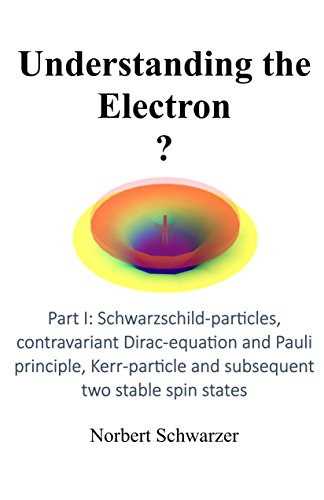
Understanding the Electron - Part I: Schwarzschild-particles, contravariant Dirac-equation and Pauli principle, Kerr-particle and subsequent two stable spin states
Book Details
Author(s)Norbert Schwarzer
Publisherwww.verlag-zumkranich.de
ISBN / ASINB01CCRU6Q6
ISBN-13978B01CCRU6Q3
Sales Rank2,283,581
MarketplaceUnited States 🇺🇸
Description
Applying the method of Stamler and Co-workers for a quantized version of the Einstein field equations we will derive solutions of such equations for particles which apparently - resemble fermions. Setting the correct boundary conditions and making certain assumptions for the metric we are able to reproduce the solutions of the classical Dirac equation, this time however, without resorting to special mathematical objects like the Dirac matrices.
Application of the method on the Schwarzschild metric shows that the no hair theorem for none rotating black holes does not seem to be valid.
It will also be shown that particle at rest states do not exist.
The method also allows the direct introduction of vacuum fluctuations.
Applying the method on the Kerr metric provides us with two stationary solutions. As these solutions are restricting the metric shear component, which is the one being connected with the rotation of the Kerr object, to two opposite states with equal absolute amounts of the angular momentum we think we might interpret the two stationary Kerr-states as the two spins known from the fermions.
Application of the method on the Schwarzschild metric shows that the no hair theorem for none rotating black holes does not seem to be valid.
It will also be shown that particle at rest states do not exist.
The method also allows the direct introduction of vacuum fluctuations.
Applying the method on the Kerr metric provides us with two stationary solutions. As these solutions are restricting the metric shear component, which is the one being connected with the rotation of the Kerr object, to two opposite states with equal absolute amounts of the angular momentum we think we might interpret the two stationary Kerr-states as the two spins known from the fermions.



